
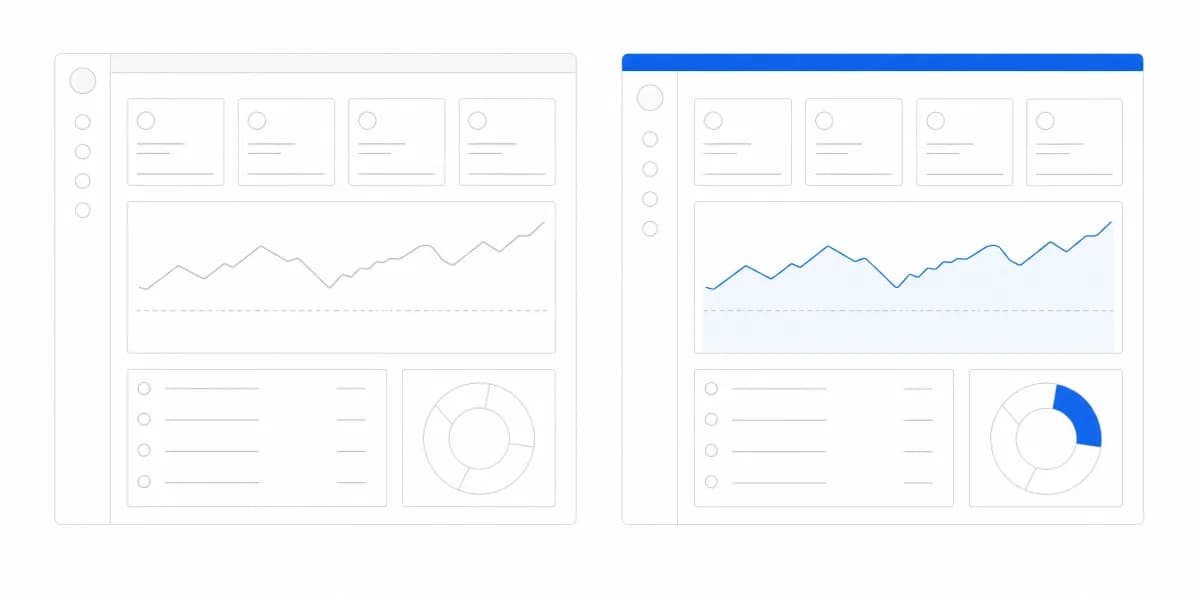
White-label analytics can describe three different agency services: branded campaign reporting, analytics embedded in a client's product, or a software offer resold under the agency's name. They share branding requirements, but their security, delivery, support, and commercial models are different.
The useful first step is therefore not choosing a vendor. It is defining which of those services the agency intends to own and what the client's end users will be allowed to do.
A rebrandable analytics solution that agencies can customize with their client's branding, embed into applications, and deliver as if built in-house, without maintaining the underlying infrastructure.
White Labelling Can Stop at a Logo, and for Agencies That Is Where the Offer Stops Too
White labelling can stop at a logo and report theme, or extend into a customer-facing product surface with authentication, tenant isolation, interactive exploration, exports, and operational support. The second case is not simply a better-looking report; it is part of the client's application.
Marketing reporting tools like AgencyAnalytics and DashThis solve one problem well: aggregating campaign data from Google Analytics, Facebook Ads, and similar platforms. But they weren't built for what comes next: agencies embedding analytics into client applications, managing multi-tenant data, or selling analytics as a standalone product.
That changes the planning question from “How do I brand this report?” to “Which parts of a customer-facing analytics product will the agency design, integrate, and operate?”
White Label Analytics Covers Three Different Agency Businesses
The term "white label analytics" covers three distinct use cases. Understanding which one (or combination) fits your agency changes everything.
1. Client reporting: the familiar model, and the one with the lowest ceiling
This is the familiar approach: connect to marketing platforms, pull data, generate branded dashboards for your clients. Tools like DashThis and Swydo excel here.
This model fits marketing agencies, SEO consultants, and paid-media specialists whose audience is the client team. It can sit inside a reporting retainer because delivery is repeated and template-driven. Effort depends on connector reliability, metric definitions, exceptions, and the amount of commentary promised, not merely on the number of dashboards.
2. Embedded product analytics: your client's customers are the readers
Your client builds a B2B SaaS product. Their customers need analytics about how they're using the platform. You help implement customer-facing analytics that looks native to their product.
This model fits development agencies and SaaS consultancies that can work inside a client's application and data architecture. A scoped implementation plus an explicit maintenance agreement is easier to price than an open-ended reporting retainer. Discovery must cover authentication, multi-tenancy, data contracts, release ownership, accessibility, and support before the agency estimates effort.
This is where embedded analytics platforms like Sumboard come in, designed specifically for embedding analytics into applications rather than generating marketing reports.
3. Reselling: the platform becomes your product, and so does its support
Your agency white labels an analytics platform entirely, selling it as your own product to clients. You handle sales, support, and branding, the platform handles the infrastructure.
This is a software business model rather than a project add-on. It suits an agency prepared to own positioning, sales, onboarding, first-line support, renewals, and the commercial relationship while the platform supplier operates the underlying product. Model the agency's gross margin after platform cost, support time, payment fees, and non-billable onboarding; a nominal markup alone does not show whether the offer is viable.
Embedded product analytics is the middle option in operating responsibility: more technical ownership than client reporting, but less commercial and support infrastructure than a reseller product. That makes it a useful starting point only when the agency already has application and data-integration capability.
Embedded White Label Requirements Start Where Marketing Reporting Requirements Stop
If you're coming from the marketing reporting world, the technical requirements for embedded analytics feel different. Here's why.
Multi-Tenant Architecture Matters
When you're embedding analytics into a client's SaaS product, their customers need to see only their data, never anyone else's.
This isn't about customizing a report template. It's about data isolation at the infrastructure level.
As explained in our white label analytics guide, a multi-tenant architecture should include:
- Row-level security or an equivalent server-enforced tenant boundary
- Signed, short-lived authentication tokens with validated audience and expiry
- APIs that carry tenant context, reject missing or mismatched scope, and produce auditable access events
Marketing dashboards aggregate data for viewing. Product analytics platforms partition data for security.
SDK-Driven Integration vs Traditional iFrames
Traditional reporting tools give you an embed code, usually an iFrame that loads their branded interface. For marketing reports, that's fine.
For product analytics, an unadapted iframe can introduce a separate loading lifecycle, styling boundary, focus behavior, and nested scrolling. Test those behaviors in the client's real layout instead of assuming that every iframe or every SDK will behave the same way.
An embedded analytics implementation can combine an SDK with an isolated embedded surface. Evaluate the result against concrete acceptance criteria:
- Measured loading behavior on representative dashboards and devices
- Styling coverage for typography, color, spacing, states, and responsive layouts
- Deliberate scrolling, focus, keyboard, and visibility behavior
- React, Vue, or Angular SDK integration for clean implementation
- A documented performance budget and fallback behavior
Where an isolated frame is used, the SDK can coordinate configuration and application integration while the frame provides a document boundary. That architecture does not guarantee native appearance or performance by itself; the trial must verify the properties above.
Security & Compliance at Scale
When an agency delivers a report to a client, security is straightforward: one login, one dataset, known users.
When that client's customers access analytics through their product, everything changes:
- Unknown number of end users
- Varying data sensitivity levels
- Compliance requirements (SOC 2, GDPR)
- Self-service access patterns you can't predict
Branded analytics solutions may provide primitives for authentication, tenancy, and access control, but the agency and client still need to verify the configured data path, roles, token lifecycle, audit trail, and incident ownership.
Launch an Agency Analytics Offer on One Bounded Engagement With Acceptance Criteria
The safest launch pattern limits the first engagement, defines acceptance criteria, and expands only after the data and support model work in production.
Start with One Ideal Client
Don't build your analytics offering in a vacuum. Find one client who's already asking for embedded analytics or customer-facing dashboards.
Use their specific requirements to shape your service.
Choose a pilot with one representative data source, one tenant-isolation path, one user role, and one or two decision-critical dashboards. The pilot should exercise the architecture the wider rollout will use; a polished mockup on sample data does not test the risky parts.
Define Your Pricing Model Early
Three commercial structures are useful starting points:
- Implementation fee + monthly support: Scope the initial integration separately from recurring maintenance and service levels.
- Revenue Share (you pay platform costs, charge client markup)
- Value-based pricing: Tie the price to an agreed business unit only when both sides can define and audit it.
Our white label pricing strategies guide breaks down the math on each model, including how agencies calculate platform costs versus billable value.
Plan with phase exits, not a universal timeline
The figure above is an illustrative six-week schedule, not a delivery benchmark. A stronger plan gives each phase an exit condition:
- Discovery: named data sources, user roles, tenant boundaries, dashboard scope, and acceptance metrics
- Integration: authentication and a representative data path working in a non-production environment
- Dashboard delivery: agreed metrics, states, responsive behavior, and accessibility reviewed
- Production readiness: security review, monitoring, rollback, support ownership, and onboarding approved
Existing data quality, identity architecture, compliance review, dashboard count, and client feedback determine the calendar. Estimate after discovery and record dependencies separately from hands-on implementation time.
Client Onboarding Process
A structured onboarding makes ownership visible:
- Discovery workshop (map client's analytics requirements)
- Data architecture review (understand their database structure)
- Design mockups with dashboard customization (show what analytics will look like branded)
- Phased rollout (start with 1-2 dashboards, expand based on feedback)
Do not try to deliver every dashboard at once. A focused pilot reduces the number of assumptions being tested together and produces evidence for the next scope decision.
White Label Analytics Works for Agencies Serving B2B SaaS, on Narrower Terms Than the Pitch
White-label analytics can be a focused offer for agencies serving B2B SaaS companies, but only if its boundaries are clearer than a generic promise to “add dashboards.” The agency should state which data, product, design, security, and support responsibilities it owns and which remain with the client or platform vendor.
If your clients are asking for analytics beyond monthly reports, if they're building products that need embedded dashboards, customer-facing insights, or data visualization that matches their brand, this might be the service offering that separates you from agencies still delivering static reports.
Where to go next
- Embedded analytics guide: the three routes to shipping it, what each one costs in calendar time, and the four things that set your launch date.
- Embedded analytics pricing models: compare embedded analytics pricing by billing unit, production workload, excluded costs.
- Embedded Analytics articles: every article in this cluster.
Ready to add white label analytics to your agency?
See how agencies use Sumboard to deliver embedded analytics in days, not months, with no infrastructure for you to run.


