
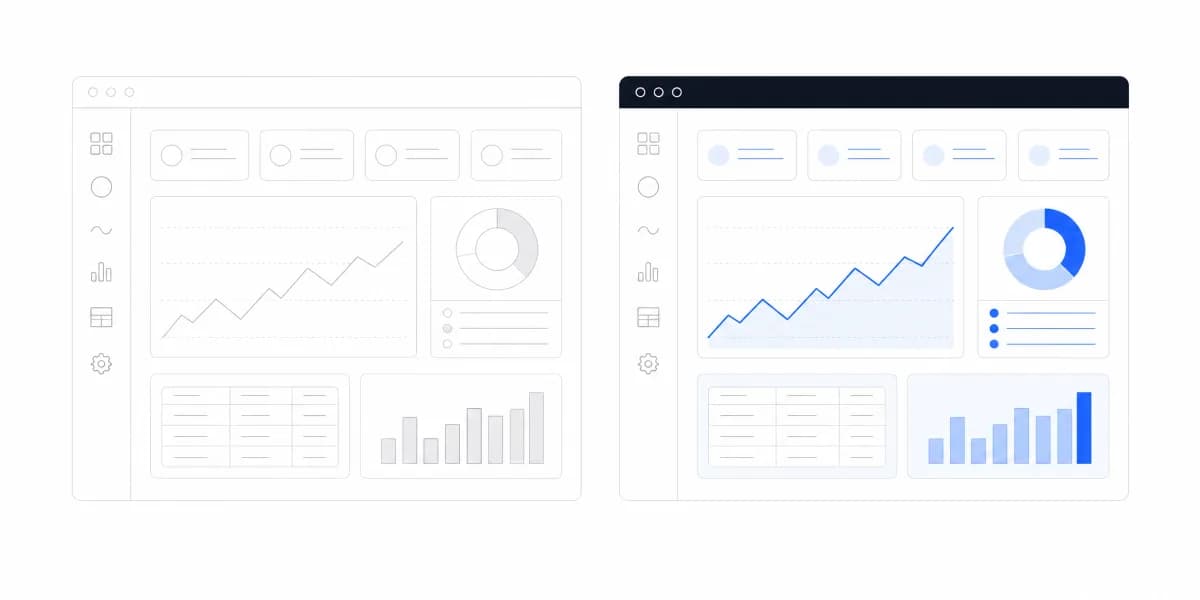
Picture this: Your customer logs into your beautifully designed SaaS product, clicks "Analytics," and suddenly sees a dashboard with a different vendor's logo, mismatched colors, and a URL like vendor-analytics.io/embed/xyz123.
The cognitive dissonance is jarring. The trust you've built evaporates.
This is the problem branded analytics solutions solve. They let you deliver embedded analytics that looks, feels, and behaves like it's part of your product, because from your customer's perspective, it is.
Branded Analytics Solutions Are Embedded Platforms That Carry Your Identity, Not the Vendor's
Embedded analytics platforms that can be fully customized to match your product's brand identity (including logos, colors, fonts, domains, and themes) so the analytics experience feels native to your application.
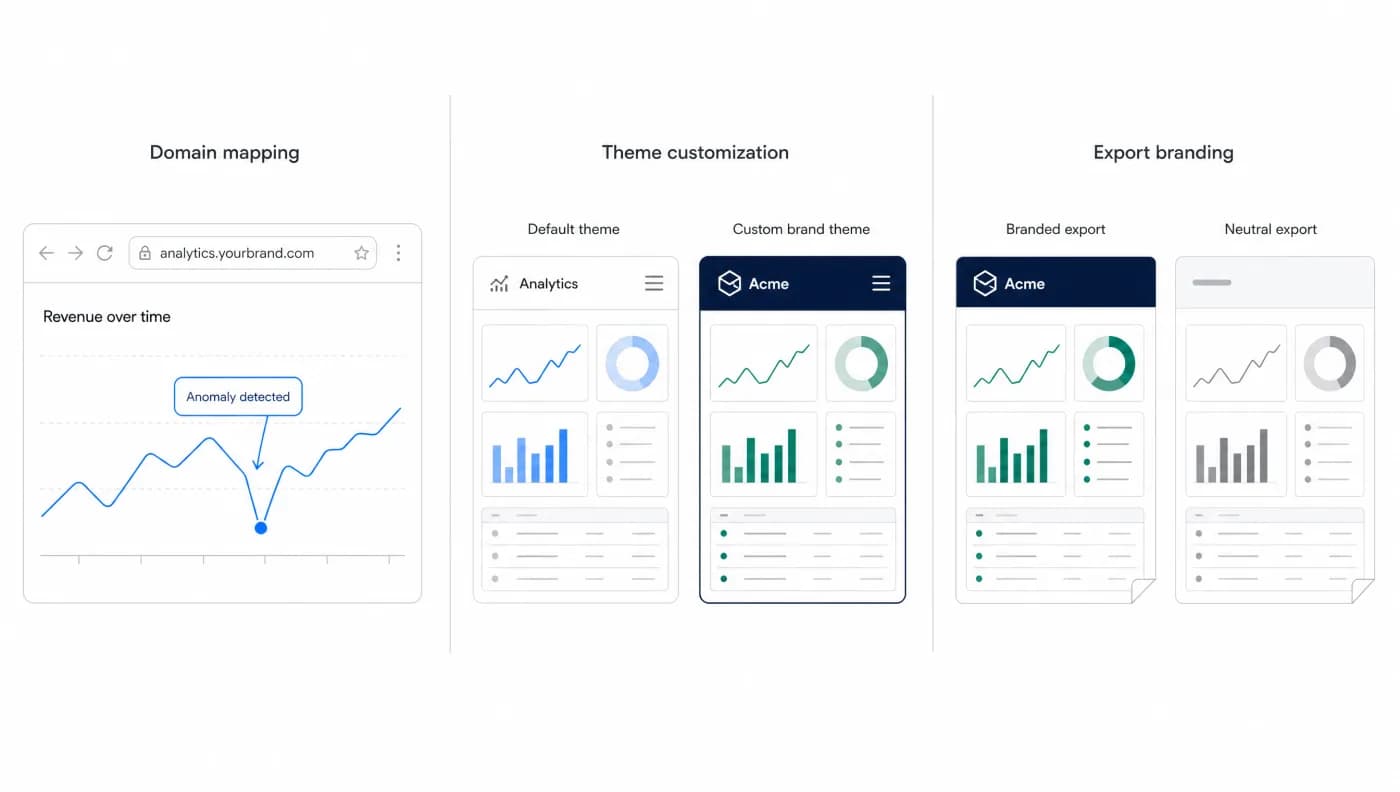
The key difference between generic embedded tools and white-label analytics is control over the user experience. Instead of accepting whatever interface the vendor provides, you get to make it yours:
- Visual identity: Your logo, your colors, your fonts
- Domain mapping: analytics.yourcompany.com (not vendor-branded URLs)
- Theme customization: Match your design system exactly
- Export branding: Even PDF exports carry your branding
The goal isn't just customization for its own sake. It's about creating a smooth experience where users can't tell (and don't care) that you're using a third-party tool.
Branded Analytics Changes Trust, Differentiation, and Adoption, in That Order
Consistent Branding Signals That You Built the Feature
Consistent branding signals professionalism. When every element of your product (including analytics) carries your identity, it reinforces that you're a legitimate, well-integrated solution.
Take Cashpad's implementation: They integrated Sumboard in 10 minutes and created a smooth analytics experience for restaurant managers. The result? Analytics became one of the first features they show in customer demos because it looks so polished.
Fully Branded Analytics Becomes Your Feature Rather Than a Vendor's
When analytics is fully branded, it becomes your feature, not a vendor's. This matters for three reasons:
- Sales positioning: You can confidently demo "your analytics" to prospects
- Feature packaging: You can monetize analytics as a premium tier (like one Sumboard customer who turned a €10K+/year cost center into a revenue stream)
- Market perception: Competitors using vendor-branded analytics look less mature
One B2B SaaS company reported paying more than €10K a year to external BI vendors for custom reports, which is that company's own figure rather than a measured average. After implementing Sumboard's white-label analytics, they not only eliminated that cost, they started selling "Advanced Analytics" as a paid tier to their own customers, turning analytics from a cost center into a revenue stream.
A Familiar Interface Gets Used, and an Unfamiliar One Gets Explained Away
Familiar interfaces drive usage. When analytics matches your product's design language, users don't experience context switching. They see it as a natural extension of your platform, leading to:
- Higher engagement rates
- Lower support burden (single login, consistent navigation)
- Better feature discovery
White-Label Comes in Three Depths, and the Word Alone Tells You Nothing
Not all "white-label" solutions offer the same depth of customization. Here's how to evaluate your options:
Level 1 reaches the visible identity elements and stops
Basic branding limits customization to the most visible identity elements:
- Logo replacement
- Simple color changes (primary brand color)
- Domain mapping (sometimes)
This level suits early-stage startups with minimal design requirements.
Limitations: Users can still tell it's a third-party tool. The interface doesn't fully match your product's design system.
Level 2 extends control from identity into the interface itself
Advanced configuration extends control from identity into the interface itself:
- Complete theme control (colors, fonts, spacing, borders)
- Advanced UI configuration via dashboard builder
- Custom login pages and branded emails
- Branded PDF exports with your logo and colors
This level suits growing B2B SaaS companies with established design systems.
Sumboard positioning: This is where Sumboard operates, deep theme customization combined with performance optimization. You get professional branding without sacrificing speed.
Level 3 hands the host control at component and state level
An SDK-first architecture gives the host product control at component and state level:
- Component-level control over the interface
- Headless architecture allowing complete UI ownership
- Native-feeling integration with smooth data exchange
- Dynamic customization based on user roles or preferences
This level suits enterprise SaaS products with unique UX requirements or strict design standards.
Technical advantage: Modern SDK-first platforms like Sumboard use optimized iframe architecture with smooth control. You get the security and isolation of iframes, but with the performance and flexibility of native components, auto-resizing, token-based authentication, and no visible scrollbars or borders.
Some platforms claim to render charts directly in your app's DOM but actually use standard iframes with performance limitations. Sumboard's optimized iframe approach delivers the best of both worlds: iframe security with native-feeling performance through smart rendering and intelligent control layers.
Iframe Versus SDK Is a Question of Where the Control Layer Sits
Understanding the technical architecture matters, especially if you're an engineering lead evaluating security and performance.
Traditional Iframe Embedding Buys Isolation and Charges for It
Traditional iframe embedding offers three immediate advantages:
- Quick initial setup
- Complete code isolation (security benefit)
- Vendor maintains updates
Its trade-offs become visible as the embedded experience grows more interactive:
- Performance overhead (additional HTTP requests, separate DOM)
- Visible boundaries (scrollbars, fixed dimensions)
- Limited parent-child communication
- Feels like "a box within your app"
SDK-first keeps the iframe as the boundary and puts the SDK around it
Sumboard keeps the iframe as a secure boundary and uses its SDK as the control layer around it:
- Uses optimized iframe architecture as the secure foundation
- SDK provides smooth control layer for communication
- Auto-resizing and dynamic sizing (no fixed dimensions)
- Token-based authentication with two-way data exchange
- Intelligent pre-loading and caching
This architecture preserves iframe-level security, including isolated execution and CSP compliance, while removing the visible rough edges. The SDK handles sizing and communication so users get smooth interactions without fixed frames or scrollbars.
For more technical details, see our guide on iframe vs SDK implementation.
Five Tests Separate Branded Analytics Platforms, and Each One Is a Question to Ask
When evaluating white-label analytics platforms, use these criteria:
1. Customisation depth, tested by what you cannot change
Test customization depth with these questions:
- Can I match my exact design system (colors, fonts, spacing)?
- Is advanced UI configuration available through the builder?
- Does domain white-labeling work for both dashboards and API endpoints?
- Are PDF exports fully branded?
2. Implementation speed, tested against your own stack
Test the real implementation effort with these questions:
- How long from signup to first branded dashboard?
- What developer resources are required?
- Is there a steep learning curve?
Reported by one customer: a 10-minute SDK setup for the initial connection (Cashpad). Building actual dashboards is fast with the drag-and-drop builder, most customers go live within days.
3. Performance, tested by the end user rather than the demo
Test the end-user experience with these questions:
- Does it feel native or "embedded"?
- What are typical load times?
- Is the mobile experience responsive?
- Can end-users customize their views (filters, date ranges)?
Sumboard's optimized rendering architecture means dashboards load in milliseconds, not seconds. Users get smooth interactions that match your product's performance standards.
4. Security, tested by trying to break the tenant boundary
Test the security model with these questions:
- Is row-level security built-in?
- Does it support token-based multi-tenancy?
- Are audit logs available?
- What compliance standards does it meet?
Sumboard documents the following security controls:
- Token filters signed in your backend, so a viewer's scope is fixed before the dashboard loads
- Role-based access controls and token authentication
- Direct connections from Sumboard's servers to your data sources, with tunnelling supported
- No copy of your data beyond cached results, which are removed when the cache timeout expires
For security deep-dive, see embedded analytics security.
5. Total cost, tested at the scale you expect rather than today's
Test total cost at your expected scale with these questions:
- Flat pricing or per-user fees?
- Hidden costs (hosting, DevOps, professional services)?
- What happens as we scale to thousands of users?
Sumboard pricing: €199-€499/month with zero per-user fees. Whether you have 10 users or 10,000, the cost stays predictable. No surprise bills, no per-seat pricing traps.
The One the Five Tests Do Not Cover: Branding Hides the Vendor From the Screen, Not From the Contract
All five above are things you can test in a trial. This one you cannot, and it arrives later, usually in a customer's security review.
Removing a vendor's logo does not remove the vendor from the data path. If your customers' data reaches an analytics platform, that platform is processing personal data on your behalf, and the GDPR describes what follows. "The processor shall not engage another processor without prior specific or general written authorisation of the controller", and under a general authorisation "the processor shall inform the controller of any intended changes concerning the addition or replacement of other processors, thereby giving the controller the opportunity to object to such changes" (Article 28 GDPR).
The liability sentence is the one worth reading twice. "Where that other processor fails to fulfil its data protection obligations, the initial processor shall remain fully liable to the controller for the performance of that other processor's obligations."
So a fully branded deployment produces an asymmetry to plan for. Your customer's users see only your product, while your customer's legal team has to see the vendor by name, in your sub-processor list, with a route to object when you change it.
Three practical consequences. Adding branded analytics is a sub-processor change for every existing customer, not only a feature release, so the notification obligation is part of the launch rather than a follow-up. Switching platforms later repeats it, which is a switching cost that never appears in a pricing comparison.
Article 28 also carries an obligation that arrives at the end rather than at launch, when the processor deletes or returns the data and deletes the existing copies that law does not require it to keep, which is the part of GDPR embedded analytics finds hardest.
This section names a legal mechanism and is not legal advice. Read your own contracts and the current text, because the wording that governs you is the one in your agreements rather than the one summarised here.
Building Branded Analytics Costs Months of Engineering, Buying Costs a Subscription
The classic make-or-buy decision with real cost implications:
Building in-house reaches basic functionality in six to twelve months
Reaching basic functionality in-house typically takes 6-12 months. The cost is a dedicated engineering team during that period, estimated here at $200K-500K+, plus a continuing share of engineering capacity afterwards.
Result: Fully custom-branded solution, but expensive and time-consuming. Your engineering team becomes permanently responsible for a non-core feature.
Buying moves the timeline to days and leaves integration with you
Buying reduces the initial timeline to days or weeks; Cashpad reports a 10-minute SDK connection for its initial setup. Sumboard's published Growth and Business prices are €199-€499 per month with no per-viewer fee.
Result: Professional, enterprise-grade analytics with no infrastructure for you to run. Your team stays focused on your core product.
Over ten years the two have different shapes rather than one comparable total. Sumboard on its published Growth and Business tiers is €23,880-€59,880 of licence at today's price, with Enterprise quoted separately. A build is your own salaries for the first version plus a decade of the capacity it keeps occupied. Run that line with your numbers before accepting anyone's saving figure, ours included.
For detailed analysis, see build vs buy embedded analytics.
Teams often underestimate the ongoing cost of in-house analytics. The initial build is expensive, but the real killer is a continuing share of engineering capacity burden, bug fixes, feature updates, new chart types, security patches, and scaling infrastructure.
Two Documented Implementations, With What Each Customer Actually Reported
Cashpad reports connecting in 10 minutes, then applying full white-labelling
Cashpad needed analytics that matched its modern product design, then connected Sumboard in 10 minutes and applied full white-labeling.
Result: Analytics became a core demo feature. Restaurant managers now make daily operational decisions based on real-time dashboards that look like a native Cashpad feature.
External filters capability: Cashpad integrated filtering directly into their parent product interface, giving users smooth control without context switching.
One B2B SaaS customer replaced outsourced reports with a paid analytics tier
This B2B SaaS company reported paying more than €10K per year to external data-service companies for custom reports, which is that company's own figure rather than a measured average. It replaced that workflow with Sumboard's white-label analytics.
Result: Eliminated external costs AND started monetizing analytics as a premium tier. Analytics went from cost center to revenue stream.
For more implementation stories, explore our customer-facing analytics guide.
The Roadmap Starts With the Customisation Depth You Actually Need
Ready to deliver branded analytics to your customers? Here's your roadmap:
Week 1: Evaluation
- Audit current analytics gaps
- Define branding requirements (design system, domain needs)
- Assess technical requirements (security, performance, integrations)
- Review what white-label analytics means for implementation best practices
Week 2: Implementation
- Set up SDK (10-minute connection for Sumboard)
- Configure white-label settings (logo, colors, domain)
- Build first dashboard with sample data
- Test across devices and user roles
Week 3: Production Launch
- Connect to production data sources
- Configure row-level security and multi-tenancy
- Train internal team on dashboard management
- Launch to initial customer segment
Ongoing: Optimization
- Monitor usage analytics
- Gather customer feedback
- Add new dashboards based on demand
- Consider monetization strategies (premium analytics tier)
Decide Whether Branded Analytics Should Be Built or Bought
Branded analytics solutions transform how your customers perceive and use your product. When analytics matches your product's look and feel, it stops being "that embedded tool" and becomes "your analytics feature."
Modern SDK-first platforms make this possible without the build. Sumboard offers white-labelling on a published price of €199-€499/month with no per-viewer fees; other platforms in the category range from that up to quote-only, so check the specific vendor.
The question isn't whether to white-label your analytics. It's whether to build or buy. For most B2B SaaS companies buying wins on speed and on maintenance burden. On cost it turns on your own salaries, so run that line before deciding.
Continue with the resource that matches your next implementation decision:
- Explore Sumboard's embedded analytics platform capabilities
- Read the white-label analytics guide for implementation details
- Learn about white-label dashboard customization options
- Review headless BI architecture for advanced use cases
Where to go next
- Embedded analytics guide: the three routes to shipping it, what each one costs in calendar time, and the four things that set your launch date.
- Embedded Analytics Benefits: from 10-minute integrations to new revenue streams.
- Embedded Analytics articles: every article in this cluster.
Ready to launch customer-facing analytics?
Stop losing customers to competitors with better analytics. Sumboard's customer-facing analytics platform lets you launch self-service dashboards in days, not months.


