
Complete data infrastructure modernization
Complete migration from legacy data systems to modern, scalable infrastructure. We handle everything from planning to deployment, plus customer-facing analytics.
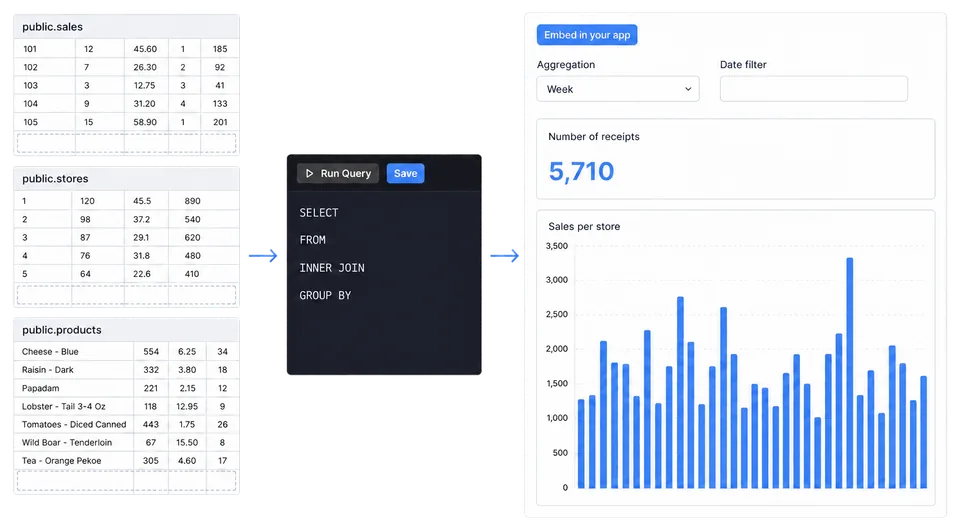
Why consider a data warehouse migration?
Most SaaS companies built their data infrastructure years ago when their needs were simpler. As businesses grow, these legacy systems become bottlenecks that limit growth, slow down analytics, and make it impossible to offer customer-facing insights.
A modern data warehouse migration isn’t just about better performance, it’s about unlocking new revenue opportunities through customer-facing analytics while reducing the maintenance burden on your engineering team. If you’re weighing how to deliver those insights, our complete guide to embedded analytics walks through the architecture and build-vs-buy trade-offs.
Common signs you need a migration
Slow analytics
Reports take hours or days to generate, limiting real-time decision making
Engineering overhead
Your team spends more time maintaining data infrastructure than building features
Scaling limitations
Your current system can't handle growing data volumes or user loads
Limited customer insights
You can't offer customers the analytics they need because your infrastructure won't support it
The data is scattered, messy, or cannot be trusted.
Four situations we are called into. If one of them is yours, the dashboard is not the blocker; the data underneath it is.
Scattered
The numbers live in five systems and a spreadsheet joins them. Somebody exports, pastes and formats before a customer sees a figure.
Messy
The same customer appears three ways, dates come in two formats, and nobody trusts the totals.
Cannot be trusted
Finance and product report different revenue and both defend their query. The definition lives inside each query; there is no single place it is written down.
Nobody owns the pipeline
The person who wrote the ETL has left. Changes are routed around it instead of through it.
What’s included in our data warehouse migration service
- Complete infrastructure assessment and migration planning
- Modern data warehouse setup (Snowflake, BigQuery, or Postgres)
- Data pipeline migration and optimization
- Customer-facing analytics platform integration
- Security and compliance setup
- Team training and documentation
- Performance monitoring and optimization
- 3 months of post-migration support
Our migration process
We follow a proven methodology that minimizes downtime and ensures a smooth transition to your new data infrastructure.
Discovery and assessment
We analyze your current data infrastructure, identify pain points, and create a comprehensive migration plan tailored to your business needs.
- Infrastructure audit and documentation
- Data volume and performance analysis
- Security and compliance requirements review
- Stakeholder interviews and requirements gathering
- Timeline and resource planning
- Risk assessment and mitigation strategies
Infrastructure setup
We provision and configure your new data warehouse infrastructure using modern cloud platforms optimized for your specific requirements.
- Cloud data warehouse provisioning (Snowflake, BigQuery, Postgres)
- Security configuration and access controls
- Network setup and optimization
- Monitoring and alerting implementation
Data migration and validation
We migrate your data using proven ETL processes, validate data integrity, and ensure zero data loss during the transition.
- Historical data migration with validation
- Data pipeline setup
- Data transformation and cleaning
- Comprehensive testing and quality assurance
Customer-facing analytics integration
We integrate our customer-facing analytics platform so you can immediately start offering powerful insights to your customers.
- Sumboard analytics platform setup
- Custom dashboard development
- White-label customization
- Multi-tenant configuration
Go-live and support
We manage the cutover to your new system and provide ongoing support to ensure optimal performance.
- Coordinated system cutover
- Team training and documentation
- Performance monitoring setup
- 3 months of dedicated support
Real migration success stories
See how companies have transformed their data infrastructure and unlocked new revenue opportunities through migration, including how Cashpad shipped customer-facing analytics after modernizing its data stack.

Orbility: Complete data infrastructure modernization
Parking management platform migrated from inflexible 2013 system to modern cloud infrastructure
“Sumboard exceeded our expectations with its performance and ease of integration. We’ve now embedded it into our product line, enabling our customers to access reports through a cloud portal.”
 George CTO and CPO at Orbility

- Timeline:
- 3 months complete migration
- Scope:
- Full data warehouse + analytics platform
- Result:
- Customer-facing analytics launched immediately
Investment and timeline
Typical migration projects range based on complexity and scope
Standard migration
- Timeline:
- 2-3 months
- Investment:
- $25K - $50K
Includes infrastructure migration, customer-facing analytics setup, and support
Enterprise migration
- Timeline:
- 3-6 months
- Investment:
- $75K - $150K
Complex migrations with custom requirements, advanced analytics, and extended support
ROI typically realized within 6-12 months
Through reduced engineering overhead, faster analytics, and new customer-facing analytics revenue
Frequently asked questions.
What does a data warehouse migration cost?
A standard migration runs $25,000 to $50,000 over two to three months. An enterprise migration with custom requirements and advanced analytics runs $75,000 to $150,000 over three to six months. You get a custom proposal after the discovery call.
How long does a migration take?
Two to three months for a standard migration, three to six months for an enterprise one. The number moves with how many sources move and how much transformation logic has to be rebuilt instead of copied; data volume barely matters.
What happens to reporting while the migration runs?
It stays up. We cut over one source at a time. The old and new pipelines run side by side and we compare them row by row before we switch anything.
Do you only work with companies that use Sumboard?
No. Most engagements end with a customer-facing dashboard on top of the rebuilt data, and that is what we plan for from the start, but the warehouse and pipelines are yours whether or not you embed Sumboard on them.
When does the investment pay back?
Typically within six to twelve months, through reduced engineering overhead, faster analytics, and the revenue a customer-facing analytics tier opens up.
Ready to modernize your data infrastructure?
Schedule a consultation to discuss your migration needs and get a custom proposal for your project.
Free 30-minute consultation to assess your needs