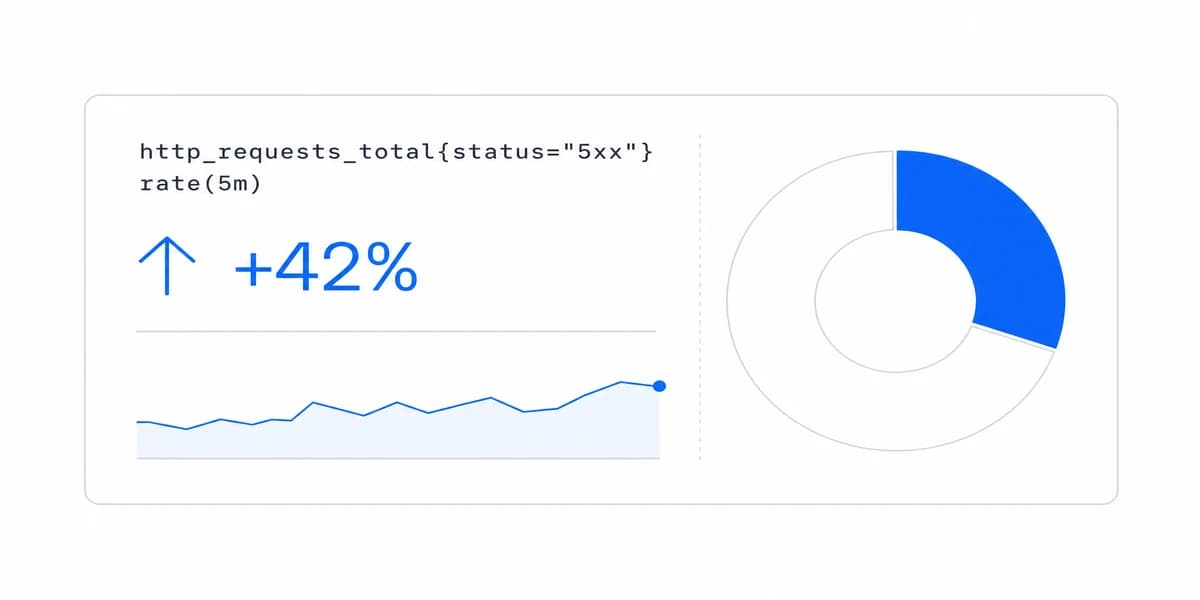
A strategic dashboard is a decision surface for objectives that unfold over time. It should show whether the organization or customer is inside an accepted trajectory, what evidence changed, who has decision rights, and which response was recorded.
It is not defined by a boardroom, a quarterly cadence, an always-on screen, or a small number of large tiles.
Start With an Objective That Can Fail
“Improve analytics,” “increase growth,” or “show customer value” cannot tell a team when the dashboard succeeded. Write an objective with:
- audience and business scope;
- baseline and measurement method;
- target or accepted range;
- horizon and review cadence;
- assumptions and constraints;
- source and metric owner;
- decision right and permitted response;
- result that would show the objective failed.
Use your own baseline and evidence. A benchmark, target, or forecast borrowed from another company does not create a valid strategic objective.
The KPI dashboard examples become strategic only when their metrics are connected to this objective and an owned decision.
Author a Priority Order That Survives Layout
Decide the hierarchy before arranging cards:
- Which metric or state answers the primary strategic question?
- Which supporting measures explain trajectory, risk, or constraint?
- Which comparison, forecast, or target gives the numbers meaning?
- Which evidence and detail are permitted when a reviewer investigates?
- Which action, owner, and next review complete the loop?
Use size, order, grouping, labels, and whitespace to express this authored sequence. Verify that DOM order, keyboard order, screen-reader output, mobile stacking, PDF export, and scheduled image preserve the same priority.
There is no universal number of metrics or natural scan path. Test the task with representative readers and realistic labels, data, and viewport constraints.
The broader dashboard design principles should support this hierarchy rather than determine it after the fact.
Give Every Metric an Operating Contract
For each strategic measure, record:
- formula, grain, scope, unit, currency, source, and freshness;
- inclusions, exclusions, missing values, and revisions;
- target, accepted range, comparison population, and effective dates;
- forecast or model version, assumptions, horizon, and uncertainty;
- reviewer, decision cadence, decision rights, and investigator;
- trigger, named response, escalation, and recorded outcome.
A customer satisfaction value of 87% is not context until the survey population, response rate, field period, segmentation, comparison, and uncertainty are visible. A change near a product release is not proof the release caused it.
Financial strategic dashboards must distinguish operational estimates, forecasts, and closed evidence. Marketing and workforce views need equivalent source, population, attribution, and privacy contracts.
Match Cadence to the Decision
Strategic does not mean slow, and modern does not mean real time. Choose cadence from:
- time in which a decision can still change the outcome;
- source-event latency and correction behavior;
- metric, reconciliation, forecast, or accounting completion;
- review and governance schedule;
- workload, cost, and customer communication;
- safe behavior when data is partial or stale.
Expose latest source event, last successful ingestion, metric or model completion, dashboard or artifact generation, expected next update, and known delay.
A frequently updated leading indicator can sit beside a monthly closed outcome, but the interface must not imply equal finality. A static review artifact can be the right surface when approval, annotation, archival, or reproducibility matters.
Use the different dashboard types guide to select modes from the decision rather than treating categories as fixed technology stacks.
Present Forward-Looking Context Honestly
Strategic planning often needs forecasts and scenarios. Keep observed, estimated, forecast, target, and scenario values visually and semantically distinct.
For each forecast, show target, horizon, training and evaluation windows, model and data versions, assumptions, uncertainty, backtest evidence, update policy, and fallback. For scenarios, show which inputs the reviewer can change and which constraints remain fixed.
Do not describe a trend projection as a likely outcome without validation. Do not turn a gap to target into an automatic recommendation unless the response policy and decision rights are explicit.
Connect Review to Decision Rights
Every strategic review should leave evidence:
- objective and metric versions reviewed;
- scope, period, comparison, and freshness;
- material variance and unresolved data issues;
- alternatives considered and uncertainty;
- decision, owner, due date, and permitted action;
- expected confirmation and next review;
- escalation, revision, or retirement rule.
A dashboard checked weekly but disconnected from a decision can still be useful awareness; it is not automatically strategic evidence. Conversely, a quarterly artifact can be strategic if it supports a governed allocation, policy, or portfolio choice.
The executive dashboard guide should be evaluated through task completion and recorded decisions, not a fixed comprehension-time threshold.
Treat Customer Strategy as a Separate Product Contract
Customer executives may need high-level outcomes, but an internal dashboard cannot simply be copied. Define customer, account, role, fields, metrics, targets, benchmarks, forecasts, evidence, and actions in trusted services.
Test scope across:
- dashboard and altered filters;
- direct identifiers and drill-through;
- caches and precomputed metrics;
- CSV, spreadsheet, image, and PDF exports;
- schedules, recipients, and attachments;
- saved views, shared links, bookmarks, and APIs;
- loading, empty, partial, stale, error, and unauthorized states;
- logs, alerts, and support tooling.
Internal targets, peer rankings, confidential plans, or cross-customer aggregates can leak through annotations, filter options, comparison sets, counts, and errors even when rows are filtered.
An embedded strategic dashboard is not automatically a customer expectation or table stake. Validate the customer task, audience, entitlement, evidence, and willingness to use or pay before treating it as a product requirement.
Test the Strategic Review End to End
Use one representative objective and known evidence:
- Reconcile source totals and calculate expected metrics, references, and forecast version.
- Authenticate the intended reviewer and deny another tenant, field, target, comparison, and action.
- Complete the intended scan, investigation, decision, and recorded handoff.
- Verify priority across desktop, mobile, keyboard, screen reader, and generated artifacts.
- Exercise missing, late, revised, partial, stale, and failed data.
- Test realistic labels, histories, concurrency, cache, export, and recovery.
- Measure interpretation errors, unresolved variance, decision completion, owner follow-through, and outcome.
A Strategic Dashboard Starts From an Objective That Can Be Proven Wrong
A strategic dashboard turns a falsifiable objective into a governed review and decision. Its value comes from metric contracts, valid references, honest forecasts, decision rights, recorded responses, and a hierarchy that survives every surface.
Start with one objective and one review decision. Expand only after meaning, hierarchy, denial, artifacts, uncertainty, recovery, and ownership pass together.
Where to go next
- Dashboard types guide: the four dashboard types sorted by how fast the reader has to act.
- Analytical Dashboard Techniques: design analytical dashboards as a governed loop from a decision question through comparison.
- Dashboard Types articles: every article in this cluster.
Ready to launch customer-facing analytics?
Stop losing customers to competitors with better analytics. Sumboard's customer-facing analytics platform lets you launch self-service dashboards in days, not months.