
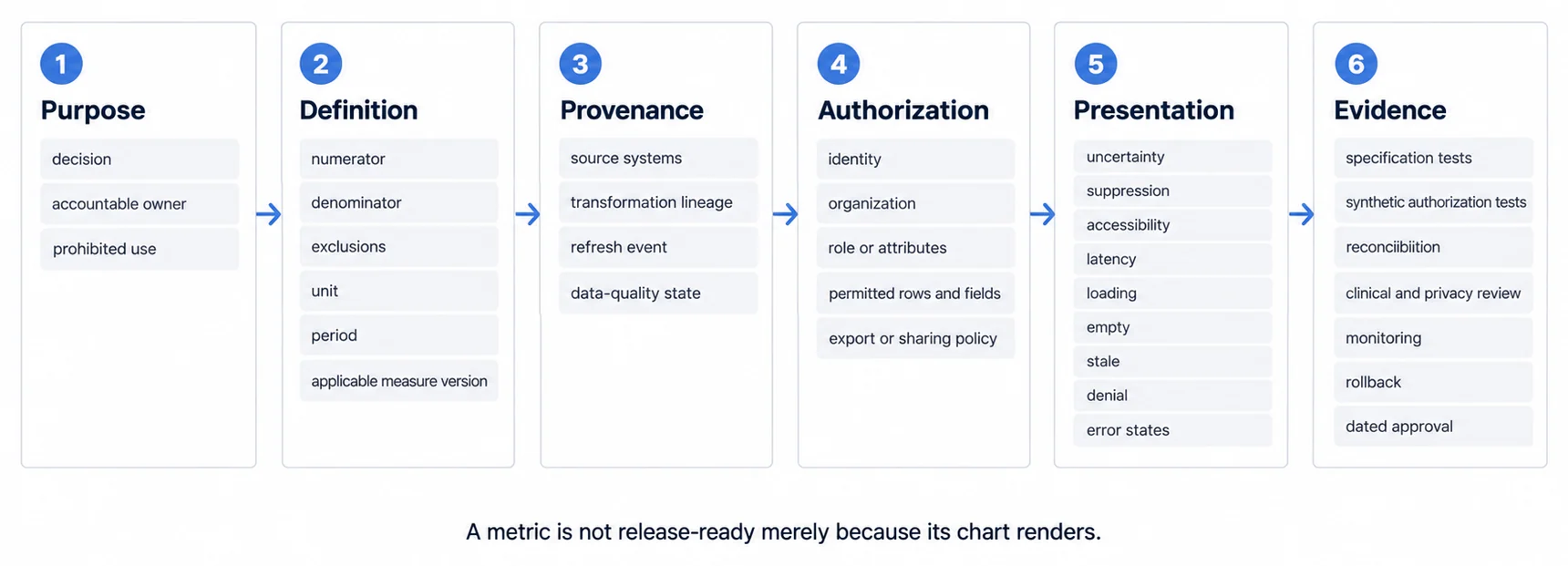
A patient analytics dashboard is not made safe or useful by selecting healthcare-looking charts. The product must connect an intended decision to a correctly defined metric, permitted data, visible provenance, appropriate presentation, and evidence that the complete path works.
This is product and engineering guidance, not medical or legal advice. Determine which laws, contracts, clinical governance processes, and regulatory programs apply to your organization and use qualified reviewers.
A Patient Analytics Dashboard Starts From a Permitted Use, Not From a KPI List
Do not begin with a list of popular healthcare KPIs. Begin with a named user, decision, setting, and consequence. A clinician reviewing a treatment context, an operations team managing a queue, a quality team preparing a program submission, and a patient reviewing personal information do not need the same metric or interface.
For each task, record:
- The question and accountable product or domain owner
- The action the dashboard may support
- Uses the dashboard is not approved to support
- The relevant population, encounter, organization, and time context
- The source-of-truth workflow when data is missing, stale, conflicting, or urgent
This also determines which dashboard type, interaction model, device, and escalation path are appropriate. Avoid claiming that a general dashboard improves clinical outcomes; that requires outcome evidence about the intervention and context, not evidence that the screen rendered.
A Clinical Quality Measure Is a Versioned Contract, and the Version Changes the Number
CMS describes quality measures as tools for quantifying processes, outcomes, patient perceptions, and organizational structures associated with quality goals. The applicable program and technical specification determine the measure, not the label alone. Link the implemented metric to its authoritative specification and version.
At minimum, record the numerator, denominator, exclusions, unit, aggregation, risk adjustment where applicable, measurement period, attribution logic, version, owner, and change history. Two dashboards can both say “readmission rate” while computing different populations and periods.
The same discipline applies outside formal quality programs. Patient experience, operational, financial, and product metrics still need definitions and reconciliation. Our healthcare KPI guide can provide candidates, but the governing specification and local decision context must decide what ships.
Patient Data Arrives From Records, Claims, Labs and Devices at Different Speeds
Patient analytics may combine electronic records, claims, laboratory results, devices, surveys, schedules, and product events. For each displayed value, preserve the source systems, transformations, refresh event, last successful processing time, quality state, and reconciliation result.
Freshness is task-specific. Define a budget with an event and percentile: for example, from an accepted source event to a visible state under named workload and failure conditions. Also define when the value becomes stale, how late or corrected data is handled, and what the user sees during partial failure. “Real-time” is not a useful acceptance criterion without those details.
Loading, empty, delayed, stale, suppressed, denied, and error states must be distinguishable. A blank chart must not force the user to guess whether there were zero events, no permission, missing data, or a failed query.
HIPAA Applies to the Entity and the Use, So Authorization Has to Survive Every Derived Path
HIPAA applicability depends on the entity, data, relationship, and use, and the same four decide which HIPAA-compliant analytics arrangements make a vendor a business associate. HHS states that the Security Rule requires appropriate administrative, physical, and technical safeguards for electronic protected health information. HHS also explains that the Privacy Rule's minimum-necessary standard is purpose-dependent and has exceptions, including certain treatment disclosures. Do not reduce either framework to “add row-level security.”
The architecture review should cover:
- Trusted authentication and authorization context
- Organization, role, attribute, row, field, and purpose constraints
- Query, aggregate, cache, export, schedule, share, support, and log paths
- Positive and negative tests with synthetic tenants and identities
- Auditability, integrity, availability, storage, and transmission controls
- Retention, deletion, incident response, recovery, and vendor responsibilities
Read the current official HHS Security Rule overview and minimum-necessary guidance, then map applicable requirements to evidence in your actual implementation. Product certification, encryption, or a database policy can be useful evidence for a subset of controls; none proves the whole system compliant by itself.
Show the Definition, Unit and Period, Because a Clinical Number Without Them Is Unreadable
Presentation should expose the context required to interpret a value: definition, unit, period, comparison basis, population, freshness, source, and uncertainty or suppression where relevant. Avoid generic red/green thresholds unless an accountable domain owner has approved the rule and its consequences.
Accessibility is part of the product contract. Test keyboard operation, focus order, names and descriptions, contrast, zoom, text alternatives, data-table access where needed, and status announcements. Responsive design is not proof that a workflow is suitable for use while moving or during care; validate the real environment and do not create unsafe attention demands.
Exports and scheduled reports are separate disclosure surfaces. Preserve metric definitions and timestamps, re-check authorization at execution time, constrain recipients and destinations, record the event, and define revocation, expiration, retention, and deletion behavior.
A First Embedded Chart Takes Minutes and a Clinical Release Does Not
An embedded analytics platform can render a first chart in minutes in a compatible example. That does not establish the time required for a supported patient analytics release. Plan and measure the complete acceptance path:
- Approve the task, metric specification, and prohibited uses.
- Reconcile representative source data and transformations.
- Test authorization and failure paths with synthetic identities and tenants.
- Complete applicable privacy, security, clinical, accessibility, and contractual reviews.
- Test workload, freshness, degradation, recovery, monitoring, and rollback.
- Pilot with defined success and stop criteria, then record a dated release approval.
Estimate each step with the systems, reviewers, and evidence your organization actually needs. Case-study integration times can suggest a technical fit test, but they are not production promises.
A Corrected Result Changes a Number Someone Already Acted On
Clinical data gets amended. A lab result is corrected, a diagnosis code is updated after review, an encounter is reclassified during coding. Each of those quietly changes a number that was displayed earlier, and in this setting the person reading it may already have done something.
That makes correction a first-class path rather than an edge case. Three parts of it are worth designing explicitly: whether a restated period is visibly marked so a reader can tell the number moved, whether the dashboard can reproduce what it displayed on a given date when someone asks why a decision looked reasonable at the time, and who is notified when a correction crosses a threshold that would have changed an action.
A system that silently recomputes history is easier to build and harder to defend, and the question it fails is the one that arrives after something goes wrong.
Compare Building and Buying Patient Analytics Against the Same Release Gate
For build, include discovery, metric and semantic work, loaded delivery capacity, infrastructure, security and accessibility work, on-call, support, data operations, maintenance, upgrades, migration, and decommissioning. For buy, include evaluation, integration, metric and dashboard work, the billing meter and commitment, internal ownership, surrounding infrastructure, add-ons, renewal, export, migration, and termination.
Require both paths to pass the same release gate. A platform can reduce the surface your team implements, but your organization still owns its data, metric definitions, configuration, authorization model, integration, validation, and intended use. Use the embedded analytics platform comparison for the broader product boundary, then review embedded analytics security and multi-tenant analytics architecture as system boundaries, not checkbox features.
The output should be a decision record with assumptions, low/base/high workload cases, risk owners, evidence gaps, exit plan, and review date, not a universal claim that one path is faster or cheaper.
Ready to launch customer-facing analytics?
Stop losing customers to competitors with better analytics. Sumboard's customer-facing analytics platform lets you launch self-service dashboards in days, not months.