A healthcare KPI dashboard is only as trustworthy as the measure specifications, data provenance, authorization, presentation, and operating controls behind it. “Readmission rate,” “patient experience,” or “bed occupancy” names a topic; it does not yet define a comparable number or a safe action.
This article is product guidance, not medical or legal advice. Determine which laws, contracts, clinical governance processes, and quality programs apply to your organization and use qualified reviewers.
Healthcare KPIs Begin With a Decision and a Setting, Not With a Category
Healthcare analytics can support many contexts: direct care, operational coordination, quality improvement, program reporting, finance, research, product operations, and patient access. Those contexts may use related data while requiring different populations, clocks, permissions, comparison sets, and review.
For every proposed KPI, name:
- The user, setting, and decision
- The accountable measure and product owners
- The governing specification or local definition
- The action the dashboard may support
- Uses the measure is not approved to support
- The source-of-truth and escalation path during uncertainty or failure
Use the healthcare dashboard guide to organize tasks and surfaces, but do not import a generic KPI list without validating the specification and purpose.
A Healthcare Measure Label Is Not a Specification, and CMS Publishes the Difference
CMS describes quality measures as tools for quantifying healthcare processes, outcomes, patient perceptions, and organizational structures associated with quality goals. CMS programs publish technical specifications and update them; the implemented measure must identify the applicable program, version, and reporting period.
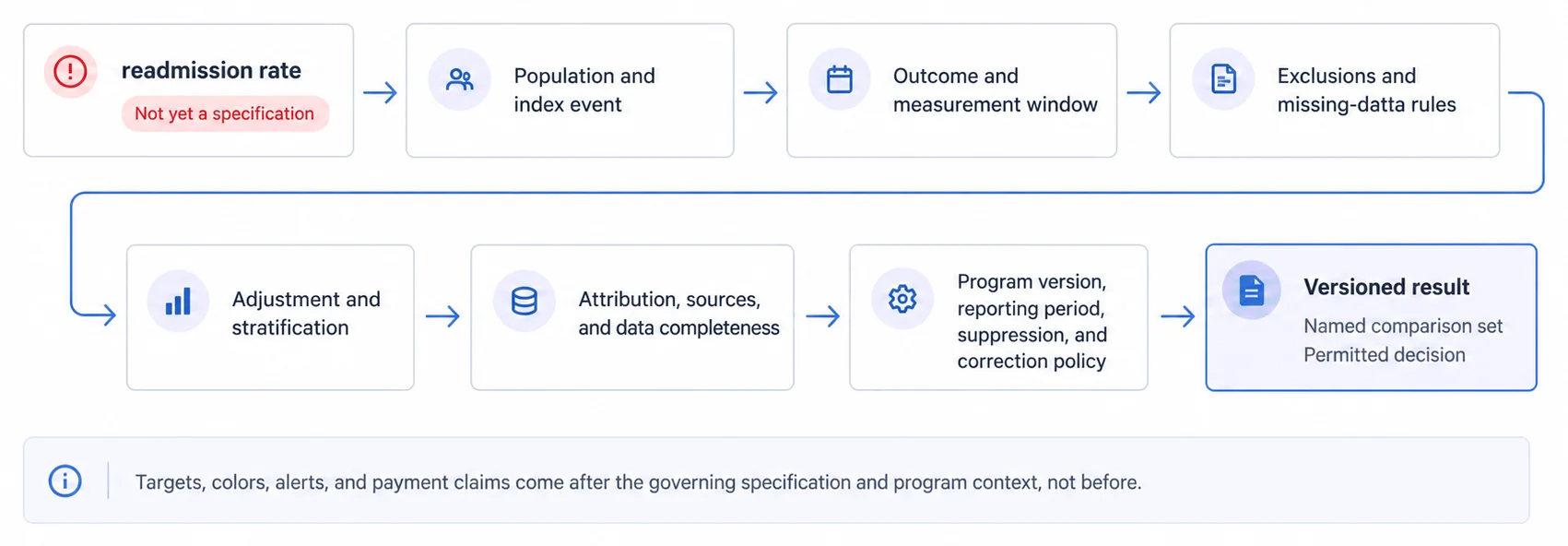
At minimum, record:
- Eligible population and index event
- Numerator, denominator, outcome, window, and unit
- Exclusions, exceptions, missing-data, and correction rules
- Risk adjustment or stratification where applicable
- Attribution, source systems, transformations, and completeness
- Program and specification version, reporting period, and suppression rules
- Comparison set, target authority, permitted decision, and owner
Use the current CMS quality-measures resources and the applicable program's technical documentation as primary evidence. A locally defined operational or product metric still needs the same discipline even when no external program governs it.
Clinical, Safety, Capacity and Finance Measures Have Different Contracts, So Keep Them Apart
Clinical outcomes, safety events, operational capacity, access, finance, patient experience, and product engagement can all be useful. They should not be treated as interchangeable evidence.
For example, a patient-experience survey measures reported experience under a defined instrument and administration method. CMS describes HCAHPS as a standardized, publicly reported survey and states that its scores play a role in the Hospital Value-Based Purchasing program. That does not mean every satisfaction score directly changes reimbursement or proves a clinical outcome.
Likewise, an association between portal use and readmission does not establish that the portal caused the difference. Cohort selection, access, health status, care setting, and other confounders can affect both. Present descriptive, predictive, and causal claims according to the evidence actually available.
The patient analytics framework covers the wider product release contract. The financial dashboard guide can inform financial presentation, but healthcare program definitions and accounting scope still govern comparability.
There Is No Correct Number of Healthcare KPIs, Only a Number That Passes the Task
There is no universal correct count. A single alerting workflow, a unit operations review, a quality-program worklist, and an executive portfolio view have different information needs. A fixed “8–12 KPIs” rule can hide a necessary measure or preserve an irrelevant one.
Build task-shaped views and test whether representative users can:
- Locate the relevant measure
- Interpret definition, period, comparison, and uncertainty
- Distinguish current, stale, partial, suppressed, and unavailable data
- Reach the permitted detail or action
- Recover from denial, error, or conflicting sources
Use progressive disclosure when it preserves context and comprehension. Tabs and drill-downs are not automatically better; they can also hide definitions or fragment a task. The dashboard types guide can help frame the view, while task evidence decides its contents.
Patient-Facing Analytics Needs Clinical Context, Not Just Simpler Words
Patient-facing analytics requires more than translating terminology. The product must explain what the value represents, where it came from, when it was measured, whether it is complete, what comparison is appropriate, and what the user can safely do next.
Reference ranges, targets, and severity thresholds can vary by test method, population, context, and individual factors. Use approved values from the responsible clinical or laboratory source. Do not borrow universal red/yellow/green zones from a design template. Pair any color meaning with text and another visible cue, and provide an accessible equivalent for complex charts.
Tooltips alone are insufficient because important information may be unavailable to keyboard, touch, magnification, or assistive-technology users. Place essential context in a persistent or equivalently reachable form. Define behavior for missing, corrected, stale, out-of-range, and urgent information, including when the product directs the user to a care or support workflow.
HIPAA Applies to the Entity, Relationship and Purpose, So Test the System You Built
HIPAA applicability depends on the entity, relationship, data, and purpose. HHS states that the Security Rule applies to covered entities and business associates and requires appropriate administrative, physical, and technical safeguards for electronic protected health information. It is not accurate to say every healthcare KPI or every consumer health product is automatically governed by HIPAA.
Use the current HHS Security Rule overview and qualified review to map applicable requirements. Then test the complete embedded analytics security boundary: identities, roles and attributes, rows and fields, queries, caches, exports, schedules, share links, support access, logs, retention, deletion, incidents, backups, and vendor responsibilities.
Row-level policies, encryption, audit logs, session controls, and tenant isolation may each be necessary controls. None individually guarantees that a patient sees only permitted information or that the complete implementation complies.
Real Time Is Not a Default Healthcare Requirement, and Claims Data Cannot Deliver It
Real-time is not a default healthcare requirement. Claims, surveys, registries, laboratory feeds, operational events, clinical documentation, and devices have different source clocks and correction behavior.
For each metric, define:
- The source event and accepted timestamp
- Expected delay and percentile under named workload conditions
- Stale threshold and visible freshness label
- Late-arriving, duplicate, corrected, and retracted data behavior
- Partial-source, timeout, and recovery states
- Whether faster refresh changes an available action
Refreshing faster than the source or review process can add load and visual churn without improving a decision. Refreshing slower than an actionable event can make the surface unsuitable. Measure the complete source-to-visible path.
Comparing Two Units Without Adjusting for Who They Treat Compares the Patients, Not the Care
A readmission rate, a length of stay, a complication rate: put two units side by side on any of them and the ranking largely reflects which patients each one receives. The unit taking the sicker, older, more comorbid population loses a comparison it never entered.
This is why case mix belongs in the metric contract rather than in a footnote. Practically it means three things. State whether a figure is raw or adjusted, and never let the two share an axis. Name the adjustment model and its version where one is applied, because the model is as much a definition as the numerator is. And where adjustment is not possible, say so and keep the comparison internal to a unit over time, which is a comparison that holds even when the population does not.
An unadjusted league table published to people with an incentive attached will change behaviour, and the cheapest way to improve on it is to change who gets admitted.
Healthcare KPI Evidence Comes From Seven Systems That Disagree About Time
Data from electronic records, laboratories, claims, scheduling, surveys, devices, and product systems requires explicit ownership. Preserve provenance and reconciliation results, monitor changes in source definitions, and version transformations with the measure.
Before release, collect specification tests, representative data reconciliation, synthetic authorization tests, accessibility results, workload and failure tests, clinical/content/privacy/security reviews as applicable, monitoring, support readiness, rollback, and a dated approval. An embedded analytics platform can reduce some implementation work, but it cannot own your measure meaning, permitted use, source quality, or governance.
The cross-industry KPI examples can supply design ideas. In healthcare, the authoritative specification and observed task must decide what the dashboard says and what action it may support.
Ready to launch customer-facing analytics?
Stop losing customers to competitors with better analytics. Sumboard's customer-facing analytics platform lets you launch self-service dashboards in days, not months.