Customer requests often include phrases like “real-time dashboards” or “live data updates.” Those labels are incomplete requirements. The useful question is how stale the visible state may be before it changes a decision, and what ordering, loss and recovery behavior the product must preserve.
Faster freshness can add source, transformation, delivery, connection, reconciliation and observability contracts. It is justified when the decision window requires them, not because motion looks modern.
What Real-Time Actually Means in Customer-Facing Analytics
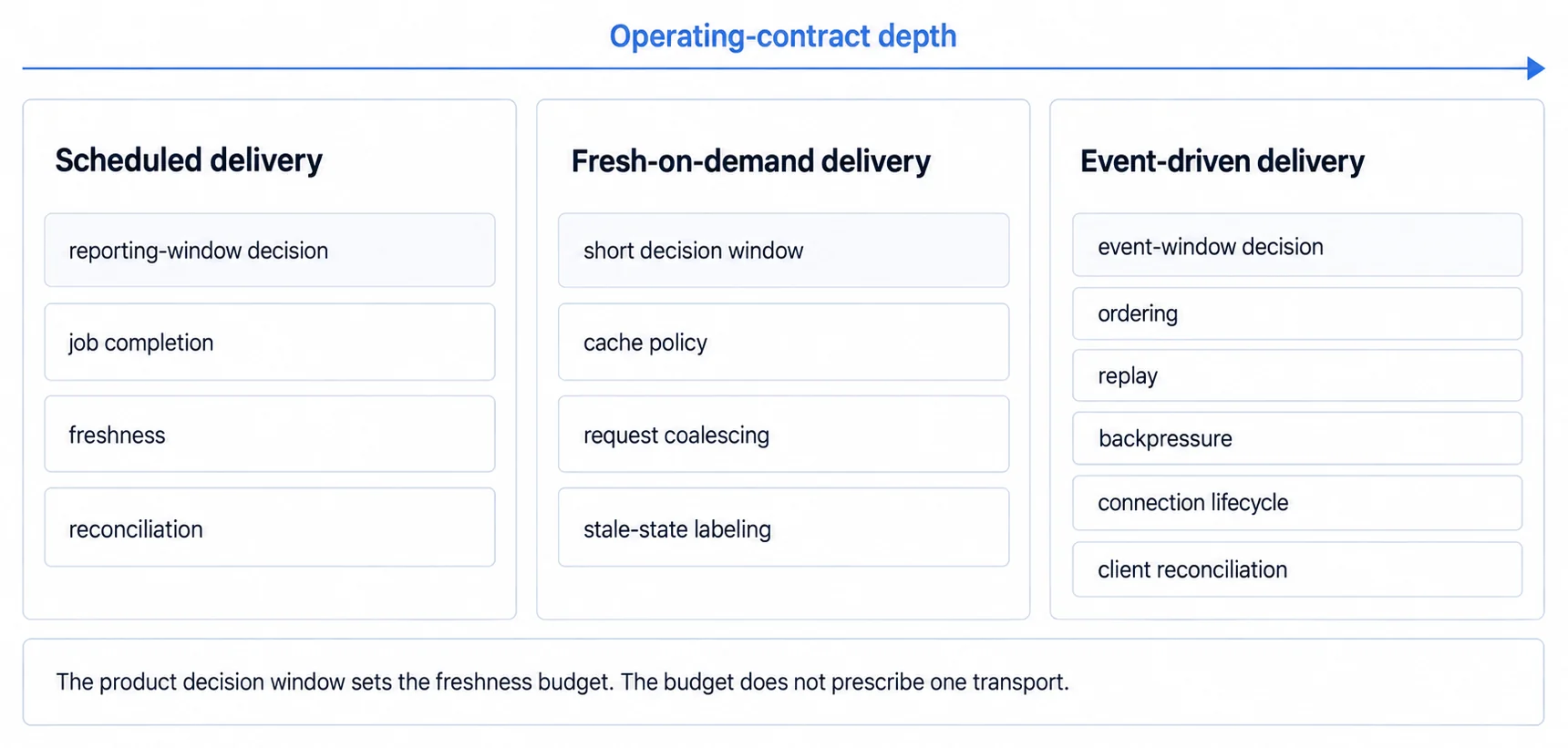
Real-time data visualization makes source changes visible within a decision-specific freshness budget. “Real-time,” “near-real-time,” and “batch” do not have universal seconds-based boundaries.
The technical requirements are fundamentally different:
Event-driven delivery can use change events, a broker, stream processing and a push transport when the workload needs ordering, replay, fan-out or continuous transformation. Not every live surface needs every layer.
Fresh-on-demand delivery can use polling, conditional requests and caching when its source-to-visible distribution and stale-state behavior pass the product budget.
The cadence should be slower than neither the action window nor the source's validated freshness. Updating faster than the source can confirm values adds motion without adding truth; updating slower than the action window makes the surface unsuitable. Measure this for the actual decision rather than borrowing a cognitive-delay claim.
Where Real-Time Visualization Creates Real Value
Real-time visualization becomes valuable when a fresher state changes an action before the next update would arrive:
Manufacturing floor monitoring shows machine performance, production rates, and quality metrics as they happen. When a production line starts producing defects, operators need to see it immediately, not 5 minutes later. The cost of even a few minutes of continued production with quality issues can be substantial.
Financial trading and market monitoring requires sub-second updates because prices change that fast. Traders make decisions in fractions of a second, and stale data means lost opportunities or increased risk.
Live operational dashboards for services like food delivery, ride-sharing, or logistics need real-time updates because the operational state changes constantly. Dispatchers making routing decisions need current location data, not where drivers were 2 minutes ago.
IoT sensor monitoring in critical systems (like industrial equipment or infrastructure monitoring) requires real-time visualization to catch anomalies before they become failures.
When Real-Time Is Overkill
Most business analytics use cases don't benefit from true real-time updates:
Sales and marketing dashboards often tolerate a reporting-window cadence, but operational campaign controls or fraud signals may not. Derive freshness per metric and action rather than per department.
Financial reporting and business metrics like revenue, customer acquisition costs, or retention rates don't need sub-second updates. The underlying business realities change slowly, and decision-makers aren't acting on this data in real-time anyway.
Historical trend analysis usually follows a reporting window, but late-arriving corrections and backfills still need freshness and reconciliation rules.
The key question is: what action becomes possible with this freshness budget that is unsafe or unavailable with the next slower budget? If the answer is not testable, the requirement is not ready for an architecture decision.
Technical Considerations for Embedded Real-Time Dashboards
Building real-time visualization into customer-facing products introduces complexity at every layer of your stack.
Data acquisition and transformation may use streaming data pipelines, change-data capture, webhooks, polling or scheduled queries. Choose from ordering, replay, transformation, fan-out, throughput and recovery requirements rather than the “real-time” label.
State and query design matter. A relational database, analytical store, time-series system, cache or materialized view can serve current state when its write, query, retention, tenant and recovery contract passes. Neither time-series storage nor a concurrency threshold is universally mandatory.
Frontend delivery can use polling, SSE, WebSockets or another channel. Polling load depends on clients, cadence, cache sharing, conditional requests and query design; a persistent connection adds its own authentication, backpressure, reconnect and lifecycle work. Measure both viable paths.
Infrastructure cost follows the workload and pricing units. Model ingestion, retained state, transformation, egress, connections, queries, regions, environments and support against expected and stress loads. Fixed and usage-based plans can both be predictable when their units and limits are explicit.
User experience can degrade when updates move layout, reset focus, erase comparison context, announce too frequently or conceal stale state. Define update batching, transitions, reduced motion, focus behavior and strategic refresh intervals, then test them with the representative workload.
Making the Build vs. Buy Decision
If you've determined that real-time visualization genuinely creates value for your product, you face the classic build vs. buy decision.
Building live analytics infrastructure in-house creates delivery and recurring ownership work across sources, ordering, replay, tenant isolation, delivery, client reconciliation, observability and recovery. Estimate those units for the actual scope; company headcount does not determine a universal implementation duration.
Our complete guide to real-time dashboards covers the technical landscape. An embedded analytics platform can own some connectors, query, tenant, embedding and visualization responsibilities. Verify the exact product and edition with the same live-update, failure, load, accessibility and security fixture; “platform” does not establish a ten-minute integration or a complete ownership boundary.
The decision depends on which responsibilities differentiate the product and which a platform can satisfy without blocking the required control, latency, governance or economics. Compare unresolved delivery units and recurring ownership on the same horizon.
Cost predictability matters too. Record the billing unit, included capacity, viewer and connection rules, overages, environments, support and price-change terms. A fixed tier can hide capacity limits, while a usage model can be predictable with measured demand; model both.
When evaluating platforms, look for these capabilities:
- Measured source-to-visible performance for the required live-update workload
- Configurable refresh intervals to balance user experience and database load
- Efficient rendering that updates visualizations smoothly without disruptive redraws
- Built-in throttling and batching to prevent overwhelming users with constant changes
- Transparent pricing units and limits that can be modeled against expected and stress loads
Where to go next
- Headless BI guide: the metrics layer underneath all of this, and what each exposure route leaves you owning.
- API-First Analytics: traditional BI tools force you to build through their UI. API-first analytics flips this.
- Architecture articles: every article in this cluster.
Add near-instant analytics without the infrastructure complexity
Sumboard's embedded analytics platform handles live data synchronization and efficient dashboard updates so your team can focus on building your core product.