

White-Label Means One Provider Builds It and Another Presents It as Their Own
White-label describes a product or service built or operated by one provider and presented by another company under its own brand. In software, the visible offer may carry the reseller's name, visual system, domain, and customer communications while the provider still owns or operates some or all of the underlying technology.
The term does not specify how much customization is included, who hosts the system, whether the arrangement is exclusive, or who owns source code and customer data. Those details belong in the product and commercial contract.
White-Label Analytics Applies That Arrangement to Dashboards, Reports and Exports
White-label analytics applies that branding arrangement to dashboards, reports, portals, exports, or analytical components. It is related to what the complete embedded analytics guide covers, but the two terms answer different questions:
- Embedded asks where analytics appears in the user's workflow.
- White-label asks whose identity appears across that experience.
A product can embed a vendor-branded dashboard. A company can also white-label a standalone analytics portal or a scheduled report without embedding it inside another interface.
Surfaces a White-Label Contract Should Name
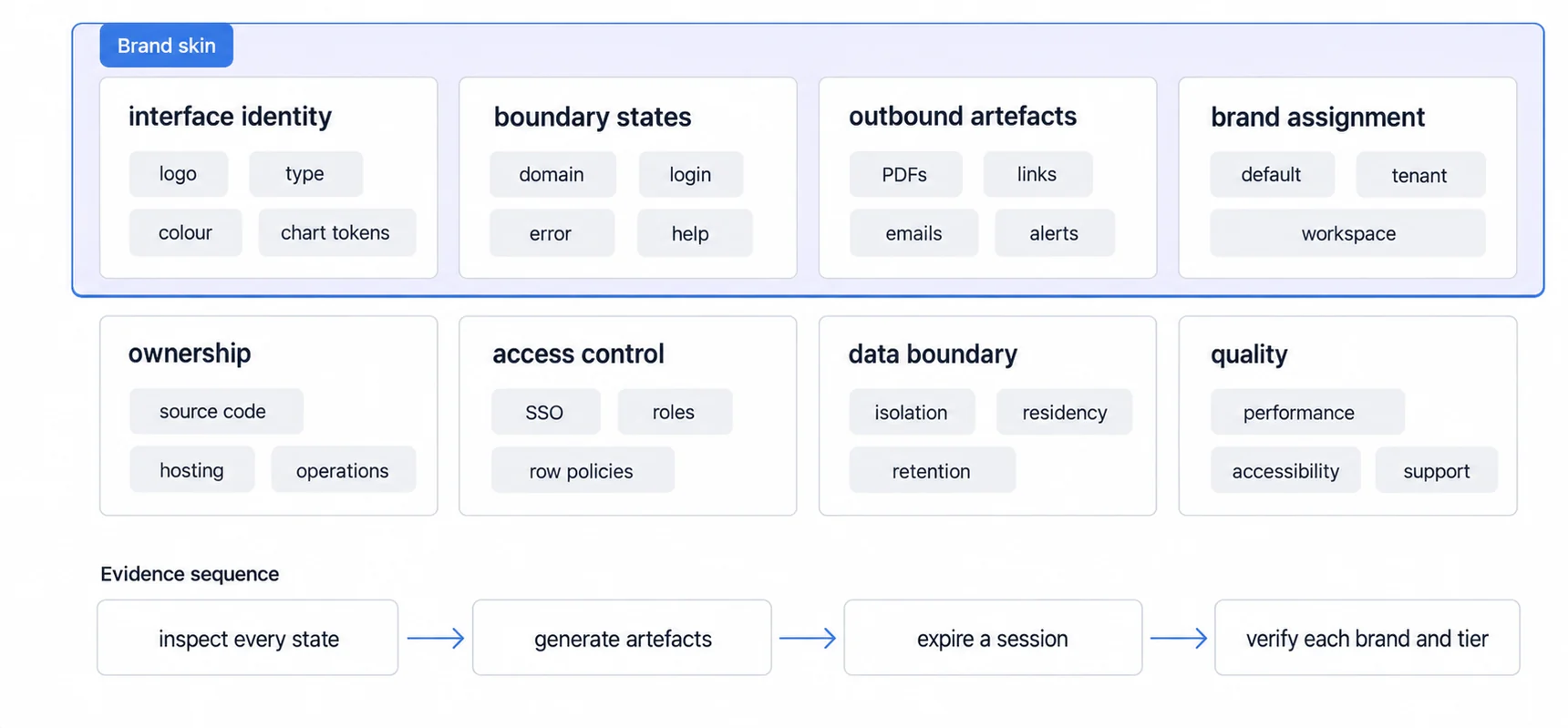
Logo and colour controls are only the visible beginning. Inventory the complete customer journey:
- Product shell: logo, navigation, typography, colour, spacing, icons, chart tokens, loading, empty, and error states.
- Domain and identity boundary: custom domain, login, consent, password or SSO errors, session expiry, logout, and help links.
- Generated and shared artefacts: PDF, image, CSV, public or authenticated links, presentation exports, and filenames.
- Messages: sender name and domain, templates, scheduled reports, alerts, invitations, and unsubscribe or preference pages.
- Support and legal identity: documentation, support routes, status pages, privacy notices, subprocessors, and required attribution.
- Multiple brands: default theme, per-tenant assignment, fallbacks, asset validation, and behavior when a new UI state ships.
A custom CNAME changes the URL customers see; it does not by itself prove who hosts the service, where data is processed, or how cookies and certificates are managed.
White-Label Is Not an Authorization Boundary
Brand selection and access control are separate systems. A tenant logo, theme identifier, URL parameter, or customer selector is not evidence that a viewer belongs to that tenant.
Use trusted identity and membership mapping, server-enforced authorization, and data controls appropriate to the architecture. Apply the same scope to dashboards, direct links, drill paths, exports, caches, alerts, and scheduled delivery. multi-tenant analytics at scale covers the wider identity, routing, data, and operations boundary.
Similarly, a custom domain or Single Sign-On flow does not prove row restrictions, object permissions, data residency, retention, encryption, audit, or compliance. Evaluate those controls independently.
White-Label Is a Set of Controllable Surfaces, Not a Single Capability
White-label capability is better described as a set of controllable surfaces than as a universal three-level maturity ladder. Common implementation models include:
A Themed Vendor Interface Stops Where the Design Tokens Stop
The provider owns the interface structure while the customer configures permitted logos, colours, fonts, and selected chrome. This can be efficient, but exact control depends on available design tokens and whether every state inherits them.
Composed Components Hand You the Layout and the Upgrade Constraints Together
An SDK supplies charts, filters, or dashboard components that the host application arranges. The product team controls more of the surrounding experience while still accepting component behavior and upgrade constraints.
A Host-Owned Frontend Buys Interface Control by Moving Testing to Your Team
APIs or a headless analytics layer supply queries, metrics, or rendered assets to an interface owned by the host product. This can maximize interface control, but it also transfers accessibility, responsive behavior, interaction design, state handling, and more testing to the product team. a component API rather than iframe lifecycle management explains that ownership trade-off.
None of these models automatically guarantees branded exports, email, authentication screens, custom domains, or removal of required attribution. Verify each surface against the selected plan and contract.
Replace the “Full White-Label” Checkbox With Evidence From the Real Artifacts
Replace a generic “full white-label” checkbox with evidence:
- List every customer-visible surface and the acceptable brand variance.
- Apply real logos, fonts, colours, domains, sender identities, and tenant mappings.
- Inspect loading, empty, error, permission-denied, expired-session, and mobile states.
- Generate every export and shared link; send invitations, alerts, and scheduled reports to a real inbox.
- Test each required brand, tenant, locale, and commercial tier, including missing or invalid assets.
- Record who owns accessibility, performance, upgrades, regressions, support, certificates, and incident response.
The White-Label Analytics Solutions guide provides a broader evaluation taxonomy. What is White-Label Analytics expands the B2B SaaS context, while White-Label Dashboard Customization focuses on implementation evidence.
Branding Depth Is Usually a Plan Boundary, Not a Technical One
The surfaces a vendor can brand and the surfaces your contract lets you brand are two different lists. Custom domains, removal of required attribution, branded email sending, and per-tenant theming are commonly gated by commercial tier rather than by what the software is capable of, which is how a demo shows a fully branded interface that the quoted plan will not reproduce. Ask which specific surfaces that tier covers, get the answer in writing, and run the verification above on the tier you are actually buying. White-label pricing strategies covers the other direction, which is how to price a branded offer you resell.
One Provider and Several Brands Fails First on the State Nobody Themed
An agency or platform presenting the same analytics under several client brands is not doing the single-brand job more times. It needs a default theme, per-tenant assignment, asset validation, and a defined behaviour for a missing or invalid logo. The failure usually appears when the vendor ships a new interface state that no tenant theme has covered yet, which is why the review has to be repeatable rather than a one-time sign-off. White-label analytics for agencies works through the operating side of running several brands at once.
Related White-Label Concepts and Embedding Boundaries
- Embedded analytics guide: the three routes to shipping it, what each one costs in calendar time, and the four things that set your launch date.
- Customization past the logo - what a customer notices when the branding is only skin deep
- Multi-tenant analytics at scale - isolation across identity, routing, data and operations
- Pricing a white-label offering - what teams charge for and what they give away
Evaluate Every Customer-Visible Surface
Compare interface states, domains, exports, messages, identity boundaries, and operating ownership before calling an analytics experience fully branded.