

Headless BI Exposes a Contract Any Consumer Can Call, Not One Vendor's Interface
Headless BI is an analytical architecture that separates presentation from semantic and query services. The analytical backend exposes a contract that dashboards, product interfaces, notebooks, agents, or other consumers can call without requiring them to use one vendor-owned visualization interface.
What Headless BI Means for Semantic and Query Contracts
The “head” is the presentation layer. Removing or making it optional lets a product team build a host-owned frontend while reusing backend capabilities such as governed entities, joins, measures, access rules, query generation, caching, or result delivery.
Headless does not prescribe one protocol. A service may expose REST, GraphQL, SQL, a proprietary query language, generated client libraries, or an SDK. It may be a standalone semantic layer, part of a broader BI platform, or an internal service.
For an embedded analytics product, ours included, this boundary can be useful when product navigation, interaction, accessibility, and white-label analytics must remain under host control. The trade-off is that the host team now owns more of the interface and its lifecycle.
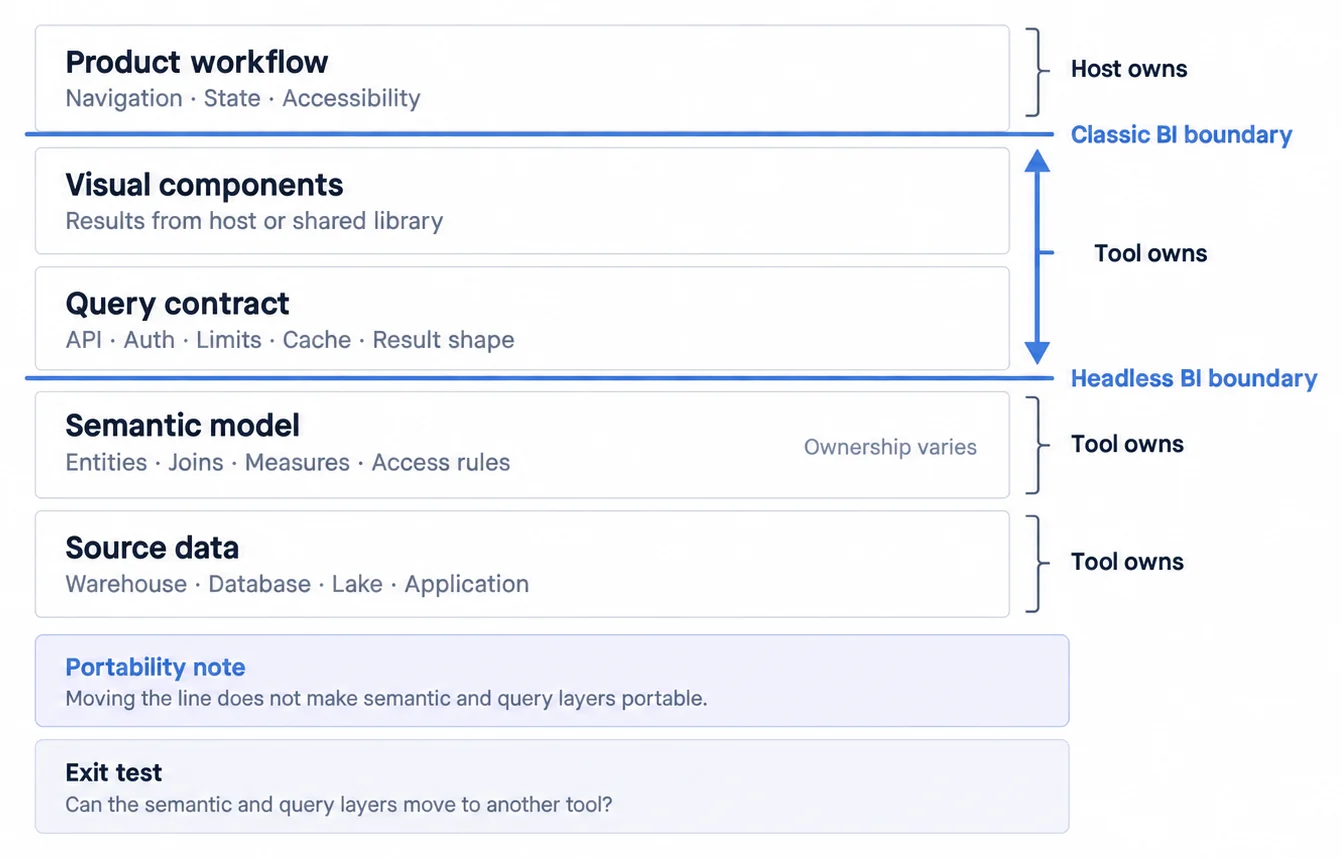
The Layers in a Headless BI Stack From Source Data to Product UI
Source Data
Warehouses, databases, lakes, and application services store the underlying data. The headless layer may query them live, use extracts or caches, or read prepared tables. Data freshness, source cost, and performance depend on that path.
Semantic Model
A semantic layer can define business entities, relationships, dimensions, measures, time behavior, and access policies. Centralization creates a place to govern definitions; it does not make them correct by itself. Definitions still need owners, tests, versioning, and change review.
Query Contract
The contract describes what consumers can request and what results mean. It includes query syntax, identifiers, filters, result shapes, errors, authentication, authorization, rate limits, caching, and version behavior. Our API-first analytics implementation guide covers this layer in more detail.
Presentation and Product Workflow
The host application renders charts, tables, filters, narratives, or actions and integrates them with its routes and state. The team should budget for component behavior, responsive layout, localization, accessibility, loading and failure states, exports, and testing, not just drawing marks.
Potential Headless BI Benefits When Contracts Are Governed
Headless architecture can provide:
- Interface control: the host team decides layout, navigation, and interaction
- Reuse: multiple consumers can call the same semantic or query contract
- Independent release cycles: presentation can evolve without publishing a traditional workbook, where API compatibility permits
- Governance leverage: shared definitions and access rules can be reviewed in one layer
- Channel flexibility: web, mobile, internal tools, automation, and agents can use the same service
These are conditional outcomes. A shared semantic layer reduces duplicated definitions only when consumers actually use it; an API supports independent releases only when it is versioned and compatible; a custom frontend improves product fit only when the team maintains it well.
What Headless BI Does Not Guarantee by Itself
Owning the Frontend Removes One Migration Surface, Not the Lock-In
Owning the frontend removes one migration surface, but a proprietary semantic language, query API, identifiers, authentication model, caching behavior, or hosted runtime can still create switching work. Lock-in is a property of the complete dependency graph, not the presence of an API.
One Service Can Hold the Definitions and Still Not Make Them True
One service can be a shared source of definitions. It cannot prevent teams from creating alternatives, and one centrally stored definition can still be wrong. Measure adoption, conflicting implementations, test coverage, and ownership rather than declaring truth from architecture.
A Callable API Is Not the Same as Framework Agnostic
An HTTP API may be callable from many frameworks, while available components, authentication helpers, event models, and browser support remain framework-specific. Verify the intended web, mobile, server, and automation clients.
Headless Often Transfers the UI Work Rather Than Removing It
Headless removes a vendor UI constraint and often transfers UI work to the customer. The total effort depends on which query, semantic, security, export, and operating services remain included.
Evaluate Headless BI Portability and Ownership Boundaries
Build a representative query and interface, then test an exit path:
- Export or reconstruct entities, measures, relationships, and access rules.
- Reproduce a governed query outside the service and compare result semantics.
- Map stable identifiers and saved state to a replacement contract.
- Replace authentication and verify tenant-denial behavior.
- Identify which caches, schedules, exports, and monitoring capabilities must be rebuilt.
This exercise reveals whether the architecture is truly modular or merely API-accessible. The SDK-first analytics guide covers client integration, while headless BI architecture goes deeper on backend responsibilities.
A Shared Semantic Model Needs an Owner and a Change Process
The whole proposition is that several surfaces read one definition. That property is what creates a governance question the layer itself does not answer: when the definition has to change, who decides, and what happens to everything already reading it.
Without a process the model fails in one of two directions. Either it freezes, because nobody is willing to alter a definition that several products depend on, and teams work around it with local calculations that reintroduce the divergence the layer existed to prevent. Or it is edited freely, and a change made for one surface silently moves a number on another.
What makes it workable is unremarkable and has to be decided early: an owner per metric domain, versioned definitions so a consumer can pin one while it migrates, a review that names which surfaces are affected before a change lands, and a changelog that customer-facing products can actually cite when a number moves.
The Query Contract Also Decides the Freshness and Cost Trade
A semantic layer can compute on request or serve from pre-aggregated results, and that choice is usually made implicitly by whoever builds the first dashboard.
Computing on request keeps every answer current and puts the cost on the source system at the moment a user asks, which is also the moment the most users tend to ask. Pre-aggregation makes the read cheap and introduces a definition of how stale an answer may be, plus the invalidation logic that keeps that promise. Both are legitimate and neither is a default: decide it per metric against the deadline that metric serves, make the staleness visible wherever the second option is chosen, and expect the same trade one layer down, where streaming and batch processing meet it with different failure modes.
Related Headless BI Concepts and Implementation Guides
-
Headless BI guide: the metrics layer underneath all of this, and what each exposure route leaves you owning.
-
White-Label Analytics Guide, for customer-visible surface requirements
-
Headless BI Guide, for implementation patterns
-
A component API against iframe lifecycle management, for packaged client interfaces
-
The real trade-offs between an iframe and an SDK, for the vendor-rendered alternative
-
Embedded analytics guide, for the wider delivery model
Evaluate an API-first analytics boundary
Test semantic definitions, query behavior, authentication, and host-owned presentation against a representative workflow.