A manufacturing KPI dashboard is only as trustworthy as the events, classifications, definitions, and reconciliation behind it. A live OEE card cannot repair an unknown downtime reason, a mismatched asset ID, or a denominator that changes between shifts.
Begin with the plant decision. Then define the metric and data path that can support it, the user allowed to act, and the evidence required to review the result.
Separate the Readers and Decisions
An operator may respond to an active stop, quality exception, or cycle deviation. A supervisor may balance labor, material, and line flow during a shift. Maintenance may prioritize work from condition and failure evidence. A plant manager may review a reconciled production period. A corporate or customer user may compare approved facilities under common definitions.
Those views should not inherit one universal refresh rate or level of detail. Name the question, permitted action, decision window, reading distance, device, escalation, and prohibited use for each role. The manufacturing dashboard guide expands the audience and device contracts.
For customer-facing analytics, distinguish the manufacturer, facility, line, asset, product, and role the host user may access. A plant hierarchy is not automatically the same as a SaaS tenant hierarchy.
Define Each Metric as a Contract
OEE combines availability, performance, and quality, but each component still needs local rules. Define planned production time, excluded breaks, changeovers, blocked and starved states, ideal cycle time, total count, good count, rework, scrap, product change, and the asset or line boundary. Version the definition when those rules change.
Cycle time needs start and end events, unit, product or route, treatment of parallel work, and a valid standard. Throughput needs the eligible output, period, constraint, and distinction between theoretical, demonstrated, planned, and available capacity.
First-pass yield needs the inspection gate, unit of count, pass rule, and treatment of rework or retest. Defect and scrap metrics need defect opportunities, severity, material or unit basis, disposition, and reversals. MTBF and MTTR need a failure taxonomy, repair boundaries, operating exposure, and rules for planned work and repeated incidents.
The KPI explains why a metric needs an owner and decision in addition to a formula. Display the definition and version from the dashboard so a user can reproduce the comparison.
Reconcile Plant Events Before Aggregating Them
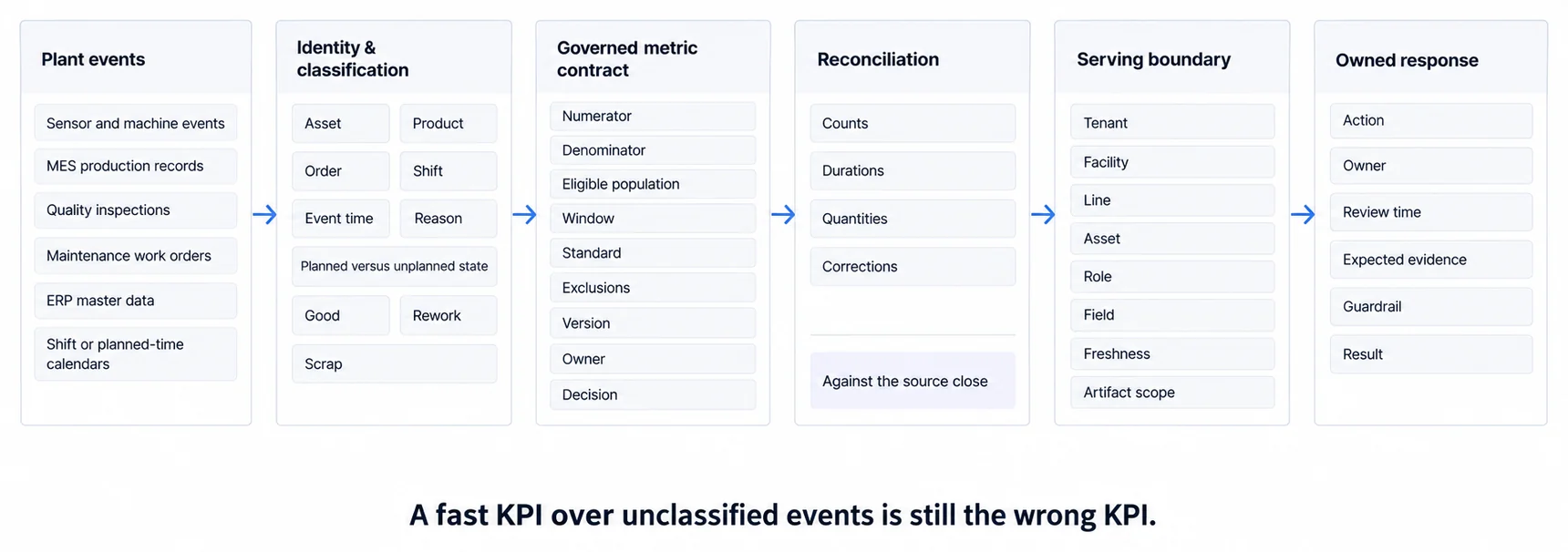
Map the required sources and clocks:
- machine controllers, sensors, historians, and IoT platforms;
- MES production, order, routing, and state records;
- quality inspections, nonconformance, rework, and scrap dispositions;
- CMMS or maintenance work orders, failure codes, parts, and labor;
- ERP product, material, order, inventory, and accounting master data;
- shift, calendar, planned-time, asset, line, and facility hierarchies.
Resolve asset, product, order, operator, shift, and reason identifiers. Record event time, ingestion time, sequence, source, correction, and accepted close. Deduplicate retries and preserve reversals. Route unknown codes for review rather than silently assigning them to “other.”
Reconcile counts, durations, quantities, good output, scrap, downtime, and work orders against the authoritative source for the period. Publish known variance and revision status. A streaming metric may be provisional during the shift and decision-safe after an agreed close.
Use Categories That Operators Can Apply Reliably
Downtime and defect analysis depends on classification quality. A long free-text list can split one cause across spelling variants; an oversized dropdown can push operators toward the first convenient option. Keep the taxonomy governed, observable, and short enough for the task while preserving detail in a secondary field when required.
Distinguish planned and unplanned time, but do not assume every planned event is harmless or every unplanned event is avoidable. Separate blocked, starved, changeover, maintenance, quality hold, material, labor, and upstream or downstream causes according to the decisions the plant can take.
Review unknown, missing, and frequently reclassified events as a data-quality KPI. Changes to the taxonomy need an owner, effective date, mapping, regression test, and historical treatment.
Diagnose Before Claiming a Cause
A lower OEE result identifies a branch to inspect: availability, performance, or quality. It does not prove why the branch changed. A cycle-time increase may come from product mix, standard version, micro-stops, material, tool condition, staffing, measurement, or incomplete events.
Use drill-through to move from the governed aggregate to the eligible events, reason distribution, time pattern, product, order, shift, asset, and maintenance or quality evidence. Keep filters, definition version, and freshness visible throughout the path.
The production analytics visualization guide covers appropriate trend, distribution, Pareto, control, and detail views. The chart should support investigation without turning correlation into root cause.
Match Freshness to Action and Source Risk
An active safety or machine condition exception may need event-driven delivery. A shift-flow decision may need frequent accepted updates. OEE used during the shift may remain provisional. Plant comparison, cost, and quality review may require a reconciled close.
Define maximum decision-safe age, event-time and watermark or close rules, stale and partial states, late corrections, owner, and recovery. A browser refresh timestamp is not data freshness.
Protect the systems the plant runs on. Test whether dashboard queries reach PLC, MES, ERP, historian, replica, warehouse, or cache, and model the load from screens left open across shifts. The real-time dashboard guide covers event-time, backpressure, serving, and recovery patterns.
Model Downtime Value Locally
There is no useful universal downtime cost per hour. For the constrained process and decision window, model lost or deferred contribution, labor and overhead that continue, scrap and restart, expedited material or logistics, service penalties, downstream disruption, recovery capacity, and any cost recovered later.
State whether the stopped asset is the current bottleneck. A non-constraint may create no immediate lost output; a bottleneck can affect the whole system. Preserve assumptions, source, currency, time basis, owner, uncertainty, and sensitivity range.
Use the model to prioritize investigation or maintenance, not to convert every minute into a guaranteed saving. After an action, reconcile actual output, cost, quality, and secondary effects.
Enforce the Customer Boundary Beyond the Filter
For embedded manufacturing analytics, bind host identity to tenant, facility, line, asset, role, row, field, action, and artifact scope in a trusted layer. Test direct URLs, modified identifiers, subscriptions, APIs, drill paths, caches, exports, schedules, shares, browser history, account switching, expiry, and revocation.
Design loading, empty, provisional, stale, partial, revised, denied, error, disconnected, and recovery states. Verify keyboard, screen-reader, zoom, reflow, touch, long labels, localization, shift displays, wall screens, tablets, print, and exports on required devices.
White-label appearance and an SDK do not prove isolation or product fit. Record who owns data, models, dashboards, tokens, incidents, source load, accessibility, support, upgrades, capacity, commercial meters, migration, and rollback.
OEE Is Three Metrics in a Trench Coat, So Publish the Three Beside It
Overall equipment effectiveness is the composite most plants already report, and it is the product of availability, performance and quality. That construction is exactly why a single OEE figure is a poor operating number on its own: three different failures produce the same drop, and the response to each one is different. A line losing time to changeovers, a line running below rate, and a line producing scrap all read as the same percentage.
Show the three components beside the composite wherever OEE appears, and let the composite serve as the summary it is rather than as the alert. The reader who has to act needs to know which factor moved.
The metric contract discipline above applies to each of the three separately, and it has to, since the composite inherits every definition dispute underneath it. Planned time excluded or included, a rate baseline set from design speed or from demonstrated best, and rework counted as quality loss or not are all choices that change the number without changing the plant.
Prove One Line Before Scaling
Select one line, difficult metric, tenant, role, device, and action. Use representative volume, shift changes, product mix, duplicates, missing events, corrections, downtime reasons, quality dispositions, late data, source slowdown, and failure states.
Measure task completion, answer correctness, denied-access results, tail latency, source load, data variance, recovery, support demand, and the later operational outcome. Reconcile the dashboard result with the accepted source close and review the action with operations.
Expand only after definitions, taxonomy, identity, runtime, operations, and rollback pass. Manufacturing analytics should shorten a controlled learning loop, not turn every plant event into an unreviewed alert.
The supply-chain dashboard guide can extend the contract beyond production into inventory, suppliers, warehouses, and transport. Sumboard or another candidate should pass the same plant-event, metric, tenant, workload, device, ownership, and outcome tests before it earns deployment.
Ready to launch customer-facing analytics?
Stop losing customers to competitors with better analytics. Sumboard's customer-facing analytics platform lets you launch self-service dashboards in days, not months.