
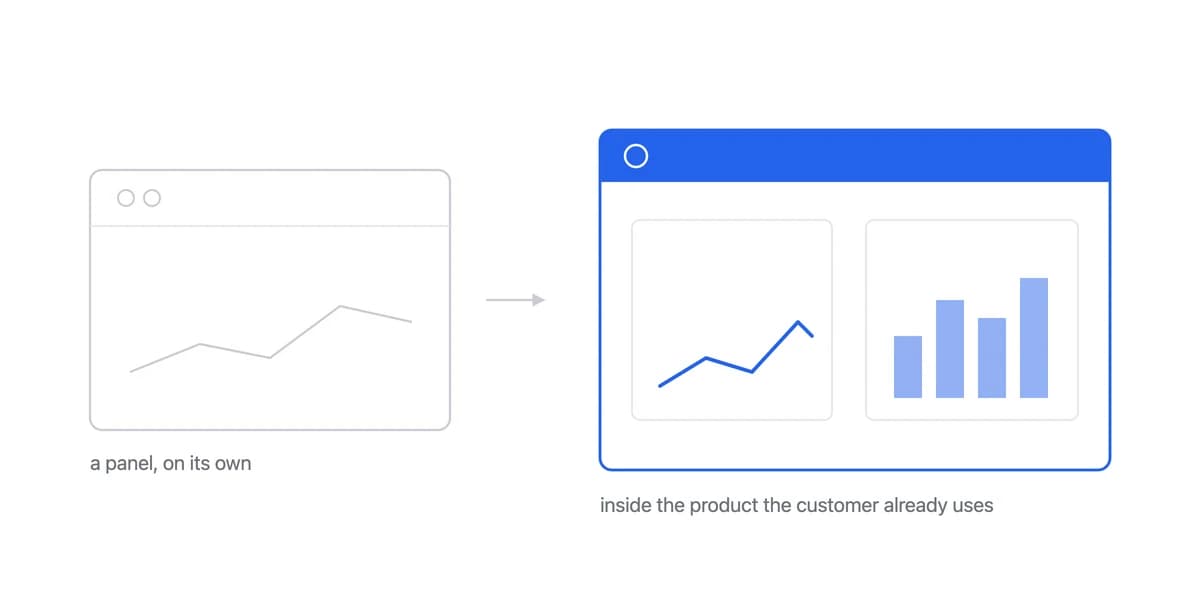
"Can we get analytics in the product?" is not yet a requirement. It can mean a status view, a downloadable report, a filterable dashboard, an investigation workflow, an alert explanation, or a customer-authored analysis.
Embedded analytics becomes useful when a defined user can complete a defined analytical task inside the surrounding product context with the correct data scope and support path.
Start with the User Task
PDFs, spreadsheets, standalone BI, and embedded views are delivery modes, not maturity stages. Each can be appropriate:
- A signed PDF can be the right immutable record
- A spreadsheet can support controlled downstream modelling
- A BI workspace can serve analysts who need broad exploration
- An embedded view can preserve product identity, account context, and workflow continuity
Research the recurring question, current workaround, decision, frequency, consequence, and required evidence. Do not add an interactive dashboard when a reliable metric or export would complete the task more clearly.
What Embedded Analytics Actually Means
Analytics capabilities integrated directly into your application, allowing users to interact with dashboards and visualizations without leaving your product.
The distinguishing feature is integration with the host product context. The user may enter through the product's navigation, retain tenant and filter context, and return an analytical action to the surrounding workflow.
That integration is not automatic. Authentication exchange, authorization, routing, responsive layout, branding, accessibility, loading and error states, telemetry, and support must be designed and tested.
The Sumboard embedded analytics platform provides an SDK-oriented delivery option. Validate its framework lifecycle, signed identity flow, tenant enforcement, data connections, theming, events, exports, accessibility, and operating responsibilities against the intended application.
How Embedded Analytics Works
At the technical level, an embedded analytical task crosses several contracts:
Data contract
Specify whether the service queries a source directly, reads a replica or warehouse, imports data, or uses an API. Document freshness, transformations, caching, query limits, schema ownership, and failure behavior. "No data movement" is a deployment property, not a definition of embedded analytics.
Semantic contract
Define approved metrics, dimensions, joins, filters, time logic, units, and owners. A polished chart does not repair an ambiguous metric.
Identity and authorization contract
Map the host identity to tenant, user, and row or object scope in trusted services. Do not trust tenant IDs, filters, or roles supplied only by browser code.
Experience contract
Define charts, tables, filters, drill-downs, exports, keyboard behavior, responsive states, localization, loading, empty, stale, partial, and error states.
Operating contract
Assign observability, rate limits, releases, rollback, support, incident response, data corrections, upgrades, and deprecation.
Technical Integration Approaches
SDK or web component
A package can manage rendering, lifecycle, messaging, events, themes, and framework integration. Inspect what it renders, how it loads code, how credentials are passed, what cleanup it performs, and which customization boundary it exposes. An SDK is not inherently native, faster, or more secure.
Iframe or shared surface
An iframe creates a document and origin boundary. It can provide strong isolation and a clear vendor-owned surface, but requires an explicit contract for authentication, cookies, content security policy, sizing, focus, keyboard navigation, deep links, messaging, downloads, and failures. Customization depends on vendor controls rather than the iframe element alone.
Headless API and custom frontend
A headless approach lets the application own rendering and interaction. It also leaves the team responsible for charts, tables, accessibility, layout, exports, state, tests, and lifecycle. Confirm that API responses and caches enforce the same authorization as the visible dashboard.
Hybrid
Use a managed dashboard for standard workflows and custom components for differentiated interactions. Define navigation, filters, metrics, and authorization once so the two surfaces do not disagree.
Evaluate Benefits as Hypotheses
Task completion
An embedded workflow may reduce exports, duplicate entry, or support-mediated reporting. Measure completion rate, correctness, time, abandonment, and escalation for the target task.
Delivery and change cost
A platform may provide charting, filters, exports, layout, and operations that the team would otherwise build. Run a representative implementation and record workarounds, extension code, vendor dependencies, and retained responsibilities before estimating delivery.
Commercial model
Compare custom development and candidates under the same workload. Include licence or subscription, implementation, data and usage limits, infrastructure, support, security review, upgrades, internal operations, and exit cost. The embedded analytics benefits guide lists outcomes that can be turned into testable assumptions. Sumboard's current pricing page lists its plan structure; recheck terms when making a purchase decision.
Maintenance boundary
A managed platform can own parts of hosting, rendering, updates, and scaling. Your team still owns product identity, authorization inputs, data quality, semantic definitions, integration code, user support, vendor governance, and coordinated incident response. The goal is a clear boundary, not "zero maintenance."
Check whether recurring reporting work, support requests, or external tooling represents a measurable cost. Then test whether the embedded workflow actually reduces that cost or supports a paid capability; neither outcome is automatic.
When It Makes Sense (And When to Build)
An embedded approach deserves a prototype when:
- A recurring analytical task belongs inside the product workflow
- The host identity and tenant context materially simplify the task
- A candidate covers important requirements without unsafe workarounds
- The expected user and business outcome justifies implementation and operating cost
B2B SaaS Use Cases
FinTech platforms: Reconciliation, transaction reporting, portfolio views, or risk workflows, subject to data, regulatory, and suitability controls.
MarTech tools: Campaign performance, attribution inputs, audience changes, and spend monitoring with explicit metric definitions.
HR technology: Recruiting, workforce, and engagement views with appropriate privacy, aggregation, and access controls.
For more industry-specific examples, see embedded analytics use cases across different verticals.
When to Build Instead
Build, buy, and hybrid are architecture choices rather than company-type rules.
Prefer a custom build when differentiated analytical behavior is central, candidate platforms fail material requirements, and a funded team can own the lifecycle.
Prefer a platform when a representative prototype proves sufficient task coverage, safe authorization, acceptable integration, and a better total ownership model.
Prefer a hybrid when standard analytical workflows can be managed while a bounded custom surface carries the differentiated experience.
Start With One Bounded Embedded Analytics Workflow
Begin with one bounded user task and a written data, semantic, identity, experience, and operating contract. Prototype the highest-risk authorization and workflow paths before designing a broad dashboard catalogue.
Test direct URLs, tenant switching, exports, caches, drill-downs, stale sessions, revoked access, empty data, timeouts, schema changes, keyboard navigation, responsive layout, and observability. Compare custom and platform routes with the same acceptance criteria.
The embedded analytics provides a shorter definition; the product page shows Sumboard's current implementation surface. For the long version, with the three implementation routes costed in calendar time, the platforms compared and twelve vendor demos, read the complete guide to embedded analytics.
Where to go next
- Embedded analytics guide: the three routes to shipping it, what each one costs in calendar time, and the four things that set your launch date.
- Embedded Analytics Implementation: most embedded analytics implementations take weeks.
- Embedded Analytics articles: every article in this cluster.
Ready to embed analytics in your product?
Evaluate Sumboard against your data, semantic, identity, tenancy, interaction, accessibility, integration, and operating requirements.


