Customer-facing analytics may need to support both observed performance and decisions about uncertain future outcomes.
That does not make predictive analytics a universal upgrade. It adds a different class of claim, with validation, uncertainty, monitoring, and decision-risk requirements.
Traditional Analytics Answers Backward, Predictive Estimates Forward, and Both Have a Place
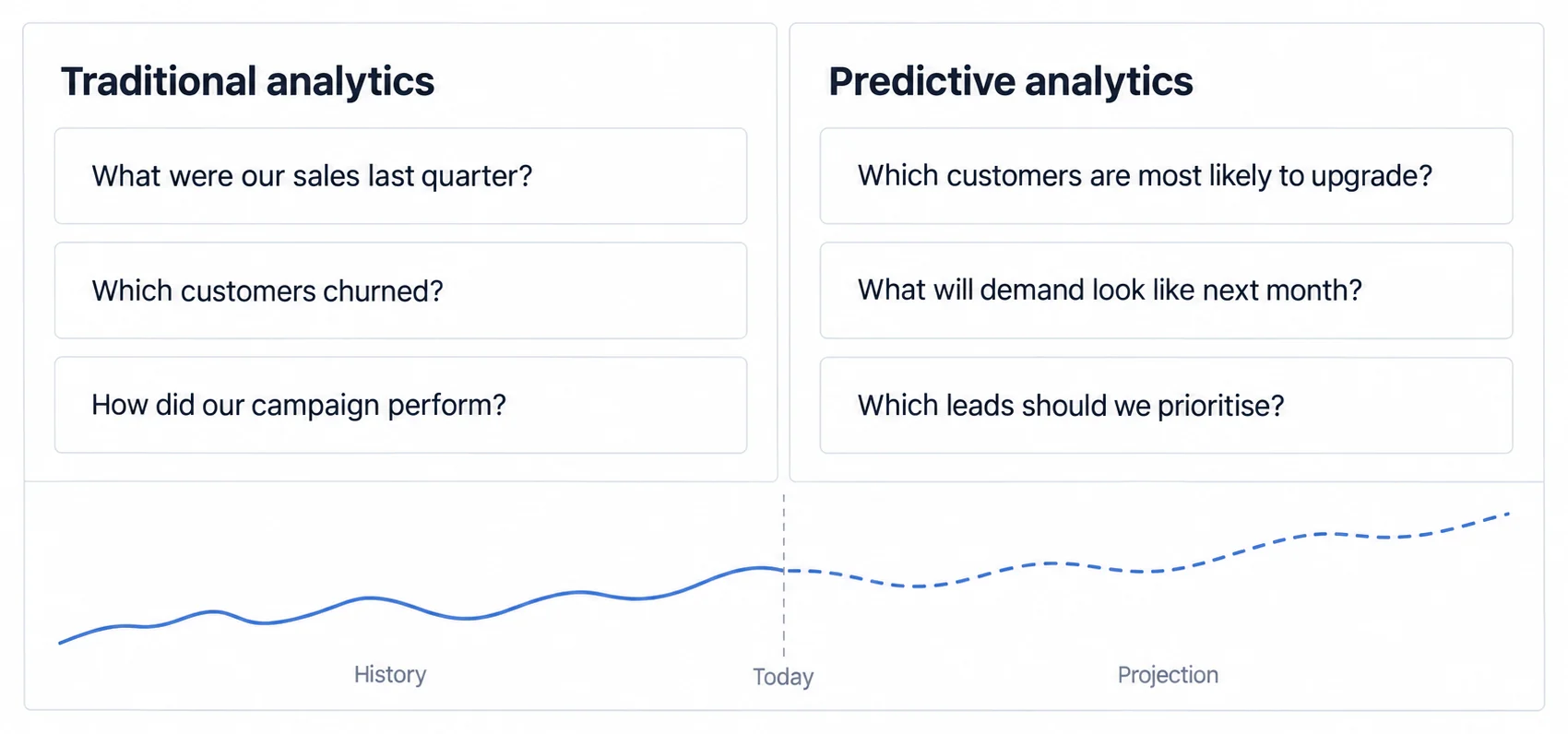
Traditional analytics answers backward-looking questions: What were our sales last quarter? Which customers churned? How did our campaign perform?
Predictive analytics estimates unknown outcomes: Which customers are more likely to upgrade within a defined period? What demand range is plausible next month? Which leads meet an agreed prioritization rule?
Both approaches have their place. The question isn't which one is "better". It's which one your customers actually need, and when.
What Traditional Analytics Does Well (And Where It Falls Short)
Descriptive analytics summarizes observations; diagnostic analysis looks for contributing factors. Classical statistics also includes predictive techniques, so the label "traditional" should not be read as "non-predictive."
Descriptive and diagnostic analysis are easier to audit, explain and reconcile
- Clear historical patterns and trends
- Well-understood statistical methods
- Straightforward to implement and maintain
- Can be easier to audit, explain, and reconcile
Customers can inspect what happened and, when the analysis supports it, investigate contributing dimensions. A retail customer comparing last month's sales by region may not need a forecast to reconcile performance through standard dashboard types.
Descriptive reporting alone does not answer a forecasting question. A predictive workflow additionally needs:
- A precisely defined target and forecast horizon
- Time-aware validation and a decision-relevant error measure
- Uncertainty or calibration appropriate to the use case
- Monitoring for drift, data failure, and performance decay
When a customer asks which products to stock next quarter, historical analysis supplies baselines and explanatory context. A predictive model can estimate demand from available signals, but it cannot automatically anticipate an unseen disruption and should expose uncertainty and overrides.
Self-service analytics can expose historical and predictive results, but model configuration, validation, and monitoring still require accountable technical and domain owners.
How Predictive Analytics Changes the Game
Predictive analytics uses statistical or machine-learning models to estimate an unknown label, value, probability, or future series from available data.
The model family is a separate choice from the analytical goal. Linear and time-series models, random forests, gradient boosting, and neural networks can all be predictive; their suitability depends on the data, target, constraints, and validation evidence.
Machine learning models can capture interactions and non-linear relationships, but added flexibility can also overfit, drift, or increase operating cost. Compare against a naive and a credible simple baseline on held-out future periods; do not assume an accuracy gain.
Here's what that looks like in practice:
- Customer churn prediction: Instead of reporting who churned last month, predictive models identify which active customers show early warning signs of churn, giving your customers time to intervene.
- Demand forecasting: A model can incorporate seasonality and available external or behavioral signals, then report a point or range forecast whose error is tracked over time.
- Lead scoring: A model can estimate a defined conversion outcome from approved signals, subject to calibration, bias, privacy, and feedback-loop review.
If you're building AI-powered analytics, add predictive capabilities only where they improve a defined decision. Combining business intelligence with AI-driven insights is often described as augmented analytics; the outcome still depends on data quality, workflow design, human oversight, and measured performance.
The Real Question: What Do Your Customers Actually Need?
Not every analytics use case requires a predictive model. Descriptive or diagnostic analysis may satisfy the decision with less implementation and operating complexity.
Prefer descriptive or diagnostic analysis when
- Historical reporting meets customer needs
- Patterns are stable and predictable
- Real-time forecasting isn't required
- Simplicity and transparency matter more than sophistication
A financial dashboard whose task is to reconcile monthly revenue trends may not need machine learning. Clear historical reporting can satisfy that task.
Consider predictive analytics when
- Customers need to forecast future outcomes
- Early intervention creates value (churn prevention, inventory optimization)
- Complex, non-linear patterns exist in the data
- A decision can use the estimate within its latency window
A predictive dashboard should show forecasted values beside actual historical performance, with the horizon, uncertainty, model version, and last evaluation visible where relevant.
Predictive analytics requires more than just flipping a switch. You need quality training data, computational resources, and ongoing model maintenance. Start with high-value use cases where forecasting accuracy directly impacts customer outcomes.
A Forecast Shown to a Customer Is Read as a Promise Unless the Interface Says Otherwise
An internal analyst reads a point estimate as an estimate. A customer reads a number inside your product as something your product knows. That gap gets closed in the interface rather than in the model.
Show the range beside the point value. Name the horizon the estimate covers. Mark clearly where actuals stop and the forecast begins, because a single continuous line invites the reader to treat both halves the same way. State when the model was last evaluated, so a stale estimate cannot pass as a current one. Most importantly, let the output decline: a prediction that has no way to say "not enough evidence yet" will say it as a confident wrong number instead, and the customer will act on it.
The Operating Cost of a Prediction Starts After It Ships
A descriptive view is finished when it is correct. A predictive one acquires a maintenance contract on release: error monitored against actuals as they arrive, a retraining trigger with an owner, a version scheme so a number that changed can be explained to the customer who noticed, and a decision about what users see while a model is being replaced.
None of that argues against shipping predictions. It explains why starting descriptive is sequencing rather than caution. The descriptive version is the one you can operate while you find out whether the estimate changes anyone's decision, and if it does not, you have not taken on the maintenance.
What This Means for Embedded Analytics
Customers may compare an analytics feature with prediction or scoring workflows in other products. That comparison does not establish that the same model, data, or decision risk applies to your product.
That doesn't mean you need to rebuild everything with predictive models immediately. It means understanding which analytics capabilities drive the most value for your specific customers, then investing there strategically.
Traditional analytics remains useful for reporting and historical analysis. Predictive capabilities are useful when a validated estimate changes a decision enough to justify model and operating cost.
If you're evaluating how to deliver these capabilities, verify what the embedded analytics platform actually supports: model inputs, versioning, uncertainty, explanations, monitoring, authorization, and export behavior. A descriptive workflow can launch first when it already resolves the target task.
The key isn't choosing between traditional and predictive analytics. It's knowing when each approach serves your customers best, and building systems that can grow with their expectations.
Where to go next
- AI analytics guide: the seven categories of AI analytics and the different question each one answers.
- Automated Insights: design automated insights as an evidence path.
- AI Analytics articles: every article in this cluster.
Ready to launch customer-facing analytics?
Stop losing customers to competitors with better analytics. Sumboard's customer-facing analytics platform lets you launch self-service dashboards in days, not months.